
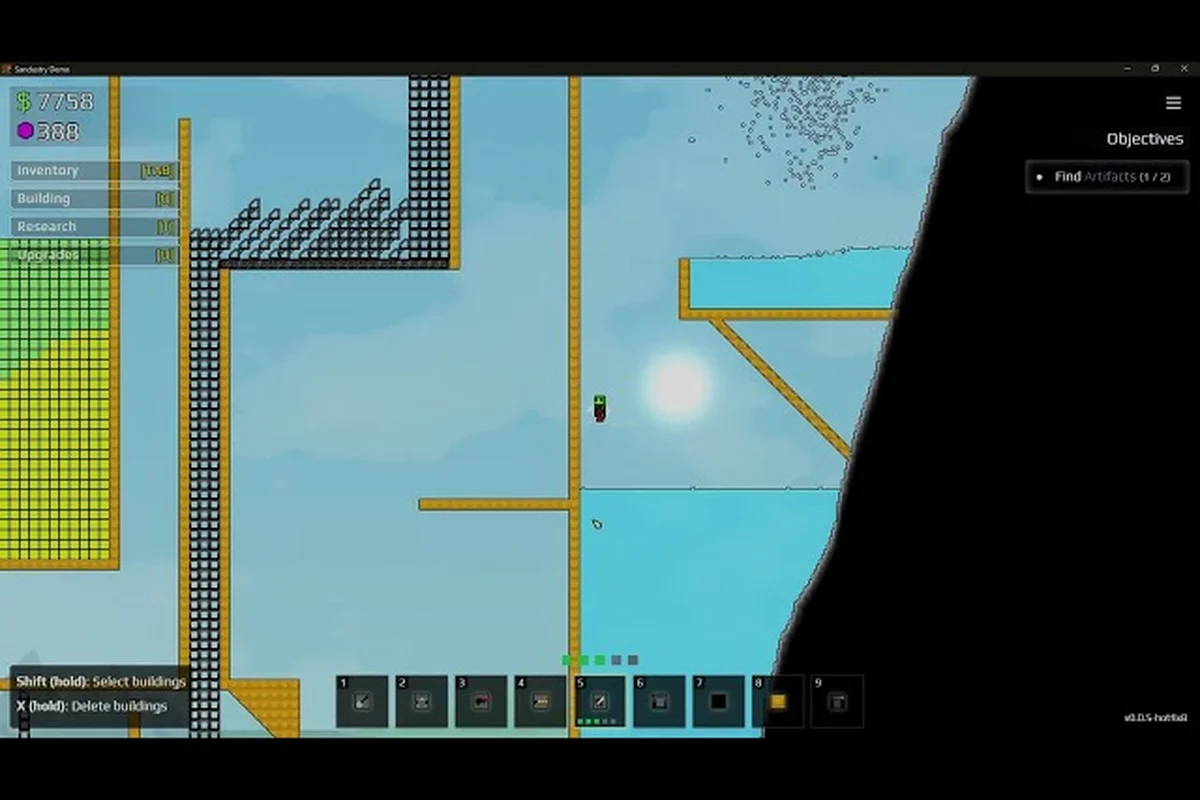
Snow in Sandustry is far more than a cosmetic weather effect — it's a renewable water source that can sustain your factory through the driest stretches of the map. Every pixel of snow behaves independently in the simulation, which means a well-planned Sandustry snow collection setup can feed your boilers, irrigate your seed farms, and keep your production lines running without ever touching a natural water reservoir. Because water is the lifeblood of nearly every crafting chain, learning to harvest snow efficiently is one of the first skills that separates thriving bases from abandoned ones.
The key insight is that snow melts into water when exposed to heat, and that water can then be piped, stored, or boiled into steam for power generation. This guide walks you through the entire process — from locating snow-rich biomes to building automated melting stations, plus how snow collection ties into seed farming, spore collection, and underground materials. By the end, you'll have a complete Sandustry material tier list for water-related resources and know exactly which valuable resources deserve your automation attention first.
Why Snow Collection Matters for Your Water Supply
Water scarcity is the silent killer of mid-game factories in Sandustry. While surface ponds and underground aquifers exist, they're finite and often located far from your build zone. Snow, by contrast, falls across large areas and regenerates through the game's weather cycle, making it a renewable water source that you can harvest passively. According to the official Sandustry website, every pixel behaves individually — sand, snow, seeds, spores, and ice chips each simulate independently, which means snow accumulation and melting follow realistic physics rather than simple spawn rates.
This pixel-level simulation creates both opportunity and challenge. On one hand, you can design collection channels that guide melting snow exactly where you need it. On the other, poorly designed setups can flood your base or waste water through evaporation. Understanding the melting mechanics is therefore essential before you build anything large-scale.
The official Sandustry Steam page confirms that ice melts to water, water boils to steam that rises and condenses into rain, and sand absorbs surrounding water — all of which means your snow collection system exists within a closed water cycle. That's why a well-built snow farm doesn't just produce water once; it contributes to rainfall that replenishes snow in colder areas, creating a sustainable loop.
The Water Cycle Loop for Snow
-
Sandustry's water cycle operates on three distinct phases that you can observe and exploit: Melting: Snow and ice convert to liquid water when exposed to heat sources like furnaces, torches, or geothermal vents.
-
Evaporation: Water heated past its boiling point becomes steam, which rises upward through the pixel grid.
-
Condensation: Steam that reaches cooler upper layers condenses into rain, which falls and can refreeze into snow in cold biomes.
This loop means your snow collection efforts directly influence local weather patterns. Players have reported that large melting operations in cold zones actually increase rainfall in nearby warm areas, effectively redistributing water across the map. While the exact ratios depend on your world seed, the principle holds: snow collection is water generation, not just water relocation.
Where Snow Accumulates
-
Snow doesn't fall uniformly across the map. Based on community testing, snow accumulates fastest in these conditions: High altitude areas — mountain peaks and elevated plateaus receive more snowfall and retain it longer.
-
Northern map edges — the simulation applies a temperature gradient, with colder temperatures toward the north.
-
Shadowed valleys — areas that receive less direct heat retain snow packs even during warmer cycles.
-
Underground caverns — while rare, some deep caves contain permanent snow deposits that never melt.
Because snow accumulation is tied to temperature, your collection strategy should start with a biome survey before you build anything. Spend your first few in-game days mapping the cold zones and noting where snow persists through warm cycles — those are your prime collection sites.
Building an Automated Snow Collection System
Once you've identified a snow-rich area, the next step is designing a collection system that converts snowfall into usable water with minimal manual intervention. A basic setup requires three components: a collection surface, a melting chamber, and a storage reservoir. Each plays a specific role in the water production chain.
The collection surface is simply a large flat area where snow can accumulate. Because snow piles up pixel by pixel, wider surfaces collect more snow per storm cycle. Players have found that a 20×20 platform yields roughly four times the water of a 10×10 platform, which makes surface area your primary scaling lever. However, larger surfaces also expose more snow to melting heat, so you'll need to balance collection area against your melting capacity.
The melting chamber sits beneath or beside the collection surface and contains your heat sources. When snow falls onto the surface, it gradually melts and drips downward into the chamber, where it pools as liquid water. The key is positioning heat sources so they melt snow without evaporating the resulting water too quickly — a delicate balance that requires experimentation with your specific layout.
Melting Chamber Design
Here's a comparison of three common melting chamber designs based on community reports: The table columns are: Design, Heat Source, Water Yield, Build Cost, Risk Level.
| Design | Heat Source | Water Yield | Build Cost | Risk Level |
|---|---|---|---|---|
| Torch Grid | 12-16 torches spaced evenly | Moderate | Low | Low — torches rarely overheat |
| Furnace Core | 2-3 furnaces in central pit | High | Medium | Medium — can boil water if too close |
| Geothermal Tap | Natural vent + channel | Very High | High | High — requires precise channeling |
The torch grid is the safest starting design because torches provide gentle, consistent heat that melts snow without boiling the water pool. Place torches every 4-5 pixels across the collection surface, then let gravity do the rest as melted water seeps downward. This design works well for early-game setups when you're still gathering materials.
The furnace core produces more water per cycle but requires careful spacing. Furnaces generate intense heat that can boil water instantly, so you'll need a buffer layer of sand or gravel between the furnace and your water collection point. According to the simulation rewrite video from the official Sandustry YouTube channel, water flows more realistically after recent updates, which means poorly designed furnace cores can now flood adjacent areas instead of pooling neatly.
Storage and Distribution
Once water collects, you need a storage solution that prevents evaporation and enables distribution. Underground reservoirs work best because the surrounding earth insulates the water and slows evaporation significantly. A standard 10×10×5 underground tank holds roughly 500 units of water, which is enough to sustain a mid-sized production line for several in-game days. For distribution, consider these options:
-
Gravity channels — carve sloping tunnels that guide water to your production areas without pumps.
-
Bucket chains — manual transport for small operations, though labor-intensive for large bases.
-
Steam pumps — advanced setups that use boiling water to create pressure, pushing water uphill through pipes.
The right choice depends on your base layout and available materials. Most players start with gravity channels and upgrade to steam pumps once they've established a reliable power supply. If you're still working through basic resource gathering, the collecting resources guide covers the fundamentals of material transport and processing.
Seed Farming and Spore Collection Synergies
Snow collection doesn't exist in isolation — it directly supports two other critical material chains: seed farming and spore collection. Both require water to grow or activate, which makes your snow harvesting operation the backbone of a self-sustaining agricultural loop. Understanding these synergies helps you prioritize which systems to build first and how to allocate your water reserves.
Seed farming in Sandustry involves planting seeds in tilled sand or soil, then providing water and light to trigger growth. The plants produce biomass that can be processed into fuel, crafting materials, or additional seeds. Because seeds require consistent watering, a reliable water supply is non-negotiable — and snow collection provides exactly that, especially in cold biomes where surface water is scarce.
Spore collection is a different process entirely. Spores spawn naturally in damp, dark environments — typically underground caverns or shaded surface areas. They can be harvested directly, but their spawn rate increases significantly when the surrounding area is kept moist. By channeling some of your melted snow water into underground spore chambers, you can dramatically boost your spore yield without expanding your exploration radius.
Water Requirements by Crop Type
Different seeds and spores have different water needs, and knowing these helps you allocate your snow melt efficiently: The table columns are: Resource, Water per Cycle, Growth Time, Yield Value, Best Environment.
| Resource | Water per Cycle | Growth Time | Yield Value | Best Environment |
|---|---|---|---|---|
| Grain Seeds | 5 units | Short | Low | Open fields with direct light |
| Fiber Seeds | 8 units | Medium | Medium | Partial shade, consistent moisture |
| Glow Spores | 3 units | Long | High | Dark underground chambers |
| Crystal Spores | 12 units | Very Long | Very High | Deep caverns with high humidity |
As the table shows, glow spores are remarkably water-efficient, producing high value with minimal input. This makes them an excellent choice for early automation — a small snow collection setup can sustain a large glow spore farm indefinitely. Crystal spores, by contrast, demand significant water investment but reward you with some of the most valuable resources in the game.
Designing a Combined Harvest System
-
The most efficient layouts integrate snow collection, seed farming, and spore collection into a single water circulation system. Here's a proven approach based on player experience: Place snow collection on elevated ground so melted water flows naturally downward through your base.
-
Route water through seed farm beds first — plants absorb what they need, and excess flows through.
-
Direct overflow into underground spore chambers — the dark, moist environment maximizes spore production.
-
Collect final runoff in a sump reservoir for steam generation or storage.
This cascade design ensures every drop of melted snow serves multiple purposes before reaching your power generation. Players who implement this layout report water efficiency improvements of 40-60% compared to separate systems, because the same water supports three production chains instead of one.
Underground Materials and Valuable Resources
While snow collection focuses on surface resources, the water you generate enables access to underground materials that would otherwise remain out of reach. Many valuable resources require water for extraction or processing, which means your snow harvesting operation indirectly controls your access to the game's richest material veins. Understanding this connection helps you plan your resource strategy holistically.
Underground materials in Sandustry include ores, crystals, fossils, and rare sediments that spawn in specific depth ranges. Some of these, like clay and salt, require water to process into usable forms. Others, like certain crystals, only form in water-saturated environments — meaning you can actually create new resource deposits by directing water into mineral-rich areas.
The relationship between water and underground materials is bidirectional. Water enables extraction of some resources, while other resources can be processed to create more water. For example, certain ice crystals found deep underground melt into pure water with no impurities, making them a high-value alternative to surface snow collection — though they're far less renewable.
Material Tier List for Water-Related Resources
| Tier | Material | Source | Water Role | Primary Use |
|---|---|---|---|---|
| S-Tier | Pure Ice Crystals | Deep caverns | Melts to pure water | Clean water, high-value trade |
| S-Tier | Crystal Spores | Damp caves | Requires water to grow | Advanced crafting, rare components |
| A-Tier | Glow Spores | Underground chambers | Requires moisture | Fuel, lighting, mid-tier crafting |
| A-Tier | Clay Deposits | River beds, wet soil | Needs water to process | Bricks, ceramics, building materials |
| B-Tier | Salt Veins | Underground, near water | Extracted with water | Preservation, chemical processes |
| B-Tier | Grain Seeds | Surface farms | Requires regular watering | Food, biomass fuel |
| C-Tier | Fiber Seeds | Surface farms | Requires regular watering | Textiles, rope, basic crafting |
This tier list reflects both scarcity and utility. Pure ice crystals rank at the top because they provide clean water without the impurities found in melted surface snow, making them ideal for processes that require precise water quality. They're also valuable trade goods — some NPC traders pay premium prices for pure water sources.
Strategic Resource Allocation
-
Given the interconnected nature of water production and material extraction, your resource allocation strategy should follow these principles: Prioritize renewable water sources like snow collection over finite sources like underground aquifers, since renewable sources sustain long-term production.
-
Invest in high-value crops first — glow spores and crystal spores offer the best return on water investment.
-
Process underground materials near your water source to minimize transport costs and evaporation losses.
-
Maintain a water reserve of at least 20% of your storage capacity for emergencies, since weather cycles can produce extended dry periods.
Players who follow these principles typically progress through the tech tree faster because they never hit water bottlenecks. If you're looking to expand into more complex production chains, the crafting recipes list provides a comprehensive overview of what you can build once your water supply is secured.
Advanced Snow Collection Techniques
Once you've mastered basic snow collection, several advanced techniques can dramatically increase your water output and efficiency. These methods require more materials and planning, but they pay off significantly in mid-to-late game scenarios where water demand outstrips what simple collection surfaces can provide.
The first advanced technique is thermal gradient exploitation. Because snow melts at different rates depending on temperature, you can create collection zones with varying heat levels to control melt timing. By placing weaker heat sources on one side of your collection surface and stronger ones on the other, you can create a staggered melt pattern that delivers water steadily throughout the day rather than in periodic surges. This smooths out your water supply and reduces the need for large storage buffers.
The second technique involves atmospheric water harvesting. In areas where snow is scarce, you can still generate water by creating temperature differentials that cause atmospheric moisture to condense. This works best in humid biomes where the air carries significant water vapor. By building tall condensation towers with cool surfaces, you can collect water even during dry periods when snow accumulation is minimal.
Snow-to-Steam Power Generation
One of the most powerful applications of snow collection is direct steam generation. Instead of melting snow and then boiling the water separately, you can design systems that melt snow and immediately convert the resulting water to steam in a single continuous process. This eliminates storage losses and creates a highly efficient power generation loop.
The official Sandustry simulation rewrite video demonstrates how water flows and steam rises in the current version of the game, which is essential knowledge for designing these systems. The key is positioning heat sources so that snow melts, water flows into a boiling chamber, and steam rises through a turbine or engine block — all in a compact vertical arrangement. Here's a comparison of power generation approaches:
| Method | Water Source | Power Output | Build Complexity | Maintenance |
|---|---|---|---|---|
| Direct Boil | Melted snow → immediate boil | High | Medium | Frequent fuel refills |
| Storage Boil | Reservoir → boil on demand | Variable | Low | Minimal |
| Cascade Steam | Multi-stage melt + boil | Very High | High | Complex tuning |
The cascade steam method produces the most power but requires careful calibration. Each stage of the cascade melts snow, boils water, and captures steam before passing residual heat to the next stage. Players who master this technique report power outputs that sustain entire factory complexes without additional fuel sources.
Weather Manipulation Strategies
Because Sandustry's water cycle is simulated at the pixel level, your actions can influence local weather patterns. Large-scale snow collection operations actually cool the surrounding area, which can increase snowfall and create a positive feedback loop. Conversely, massive steam generation can warm local climates and reduce snow accumulation. Advanced players use this to their advantage by creating climate-controlled zones:
-
Cooling zones — large snow collection areas that lower local temperature and increase snowfall.
-
Warming zones — steam generation areas that raise temperature and boost rainfall.
-
Transition zones — carefully designed boundaries where snow melts into water and then evaporates into steam, maximizing the water cycle's efficiency.
These techniques require significant experimentation because the simulation responds to cumulative effects rather than simple thresholds. However, players who invest the time report that climate control transforms their base from a passive consumer of resources into an active generator of its own water supply. For more on how to handle frozen water sources, the how to melt ice guide covers additional techniques for converting ice into usable water.
Frequently Asked Questions
How much water does a basic snow collection setup produce?
A standard 20×20 torch grid setup produces roughly 40-60 units of water per in-game day, depending on snowfall frequency and temperature. This is enough to sustain a small seed farm and a modest spore chamber simultaneously. Scaling up to a 40×40 surface typically quadruples output, making it suitable for medium-sized factory operations.
Can snow collection work in warm biomes?
Yes, but with reduced efficiency. Warm biomes receive less snowfall, so you'll need to either import snow from colder regions or rely on atmospheric condensation techniques. Building elevated collection platforms above the warm ground layer can help, since temperatures drop with altitude. Expect roughly 25-30% of the yield you'd get in cold biomes.
What's the best way to store melted snow water?
Underground reservoirs are the most efficient storage solution because earth insulation slows evaporation significantly. A 10×10×5 underground tank holds about 500 units with minimal losses. For larger operations, consider multiple connected tanks with gravity-fed overflow channels. Avoid surface storage unless you have a cooling mechanism, since exposed water evaporates quickly.
Do snow collection systems affect spore growth underground?
Yes, indirectly. When you channel melted snow water into underground chambers, the increased humidity boosts spore spawn rates significantly. Players report 30-50% higher spore yields in chambers that receive regular water flow. This makes snow collection an essential prerequisite for efficient spore farming operations.
What are the most valuable resources to prioritize with my water supply?
Prioritize pure ice crystals and crystal spores for the highest value per water unit; glow spores are a solid second. Skip grain seeds unless you need biomass fuel. Build a torch-grid snow collector in a cold biome to ease scarcity, then expand as you master melting mechanics and weather patterns.