
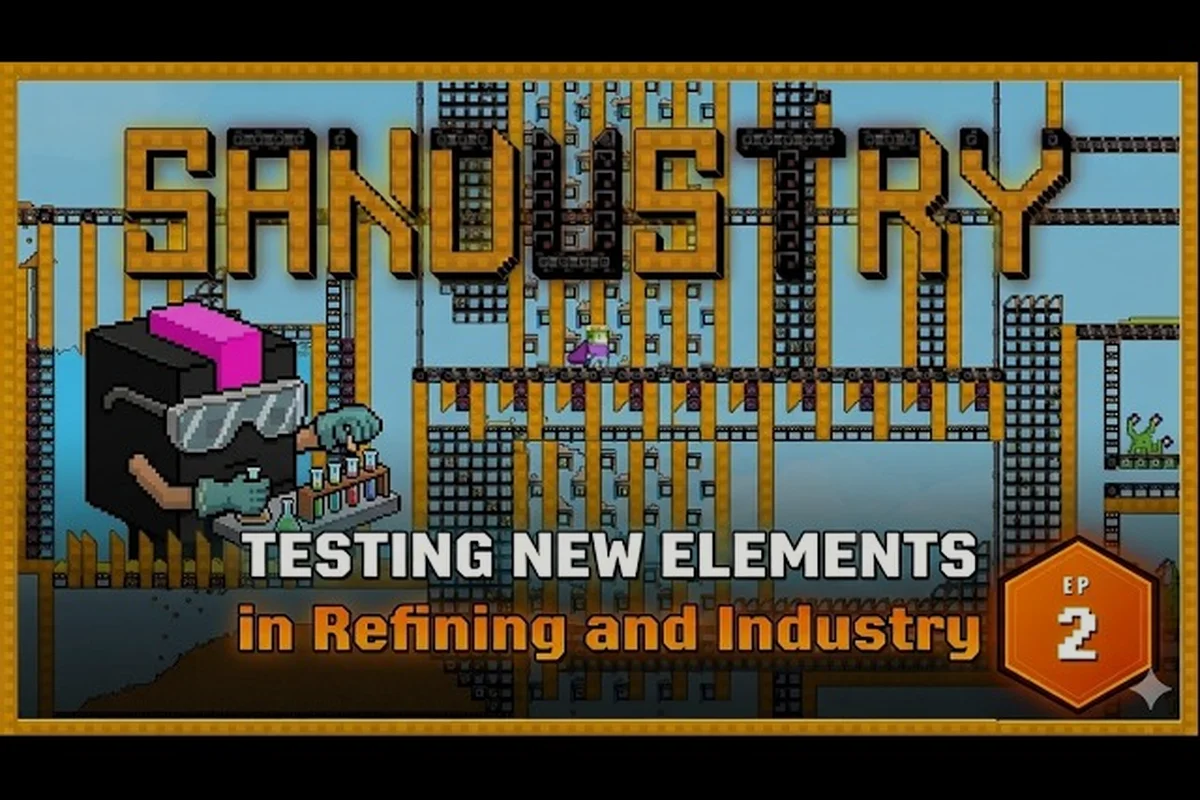
Sandustry turns the classic falling-sand toy into a full factory sim, where every pixel of sand, snow, seed, spore, and ice chip behaves independently. The Sandustry crafting recipes list is your roadmap to transforming raw elements into valuable processed materials, and this guide breaks down every input, output, and production method you need to scale from a handful of pixels to a self-sustaining industrial line. Because the game simulates each particle individually, understanding material conversion is not optional—it is the difference between a messy pile of slag and a smoothly running automated factory. Get ready to master every recipe, from melting ice to burning residue, and turn Sandustry's chaotic physics into predictable, profitable production chains.
Core Material Conversion Overview
The heart of Sandustry's progression lies in understanding how basic elements interact and transform. Rather than a traditional inventory-based crafting menu, the game relies on physical simulation recipes where heat, moisture, and contact trigger conversions. This means the Sandustry crafting recipes list is less about clicking a craft button and more about setting up the right environmental conditions for material conversion to occur naturally.
The official Sandustry website describes the core loop clearly: every pixel behaves individually, and the official Steam page confirms that ice melts to water, water boils to steam that rises and condenses into rain, while sand absorbs surrounding water and depletes reservoirs. These are not just visual effects—they are the fundamental production methods you will exploit for resource generation.
Primary Element States
| Element | Source | Conversion Trigger | Output |
|---|---|---|---|
| Ice | Spawned in cold zones | Heat source nearby | Water |
| Water | Ice melt / rain | Boiling temperature | Steam |
| Steam | Boiling water | Rising + cooling | Rain / Water |
| Sand | Initial resource | Water absorption | Wet sand (depletes water) |
| Slag | Byproduct of processing | Burning / further processing | Usable materials |
| Seeds / Spores | Natural spawns | Contact with water / soil | New growth |
The Water Cycle as a Production Method
The water cycle is the backbone of many advanced recipes. When you apply heat to ice, it melts into water; apply more heat and the water boils into steam that rises; when that steam reaches cooler areas, it condenses and falls as rain. This self-sustaining loop is one of the most reliable production methods in the game because it requires only an initial heat source and a temperature gradient.
Players have reported that mastering this cycle early makes the rest of the Sandustry crafting recipes list much easier to execute. The key insight is that water is not a final product but a catalyst—it enables seed growth, cools machinery, and combines with sand in ways that unlock higher-tier materials. According to community testing, a well-designed evaporation chamber can produce a steady stream of rain that feeds multiple downstream processes simultaneously.
Processed Materials and Their Recipes
Getting processed materials in Sandustry requires moving beyond raw element collection. The Sandustry how to get processed materials question has a clear answer: you must create controlled environments where physical triggers force conversions. Unlike other factory games, there is no crafting bench—your factory layout is the crafting interface.
The most common processed materials include glass from sand, fuel from slag, and biomass from seeds. Each requires specific conditions that you must engineer deliberately. The official simulation rewrite video demonstrates how water flows, ice melts, steam rises, and condenses into rain—all of which are mechanics you will harness for Sandustry item production.
Sand to Glass Recipe
| Input | Required Condition | Output | Notes |
|---|---|---|---|
| Sand | Extreme heat (lava or focused flame) | Glass | Requires sustained temperature |
| Sand + Water | Saturation | Wet sand | Intermediate step, depletes water |
| Slag | Burn at high temp | Burned slag | Can be processed further |
| Seeds + Water | Moist environment | Plant growth | Renewable biomass source |
Slag Processing Chain
Slag is the unwanted byproduct of many operations, but it is far from useless. The Steam description explicitly states that slag can be burned and processed further, which makes it a valuable input for advanced recipes. Burning slag produces energy and leaves behind residue that can be refined into more useful materials.
A practical approach reported by players involves setting up a dedicated slag burning chamber adjacent to your main production line. This chamber serves dual duty: it disposes of waste while generating usable heat and secondary materials. The efficiency gain is substantial because you eliminate a disposal bottleneck while feeding your Sandustry production methods with additional resources.
Recipe Tier List by Input Cost
Once you understand the basic conversions, you can begin chaining them together into complex production lines. The Sandustry crafting recipes list becomes a blueprint for designing multi-stage factories where the output of one process becomes the input of another. This is where the game transforms from a sandbox toy into a genuine logistics puzzle.
The official demo trailer shows the intended scale of these operations—players are expected to manage multiple simultaneous processes, each with its own temperature, moisture, and flow requirements. For a deeper look at how to structure these systems, check out our guide on Sandustry production chains, which covers the full progression from raw collection to advanced manufacturing.
Steam Generation Setup
| Component | Purpose | Placement | Output |
|---|---|---|---|
| Heat source | Boil water | Below water reservoir | Steam |
| Water reservoir | Supply input | Above heat source | Boiling water |
| Condensation chamber | Cool steam | Above steam path | Rain / Water |
| Collection channel | Gather output | Below condensation | Usable water |
Automating the Water Cycle
Sandustry how to automate production begins with the water cycle because it is the most predictable conversion in the game. By positioning a heat source beneath a water reservoir and placing a condensation chamber above, you create a perpetual motion machine that requires no manual intervention. The steam rises, cools, condenses, and falls as rain, which you can channel back into the reservoir.
Players who have automated this loop report that it frees up significant attention for other tasks. The key is to balance heat input with cooling capacity—too much heat and the steam escapes; too little and the water never boils. Community reports suggest starting with a small setup and scaling gradually, because the pixel simulation can behave unpredictably at larger scales.
Production Line Design and Optimization
Designing an efficient production line requires thinking in terms of material flow and temperature zones. The Sandustry crafting recipes list tells you what inputs produce what outputs, but it does not tell you how to arrange your factory for maximum throughput. That knowledge comes from understanding the physics engine and learning from player experience.
The official simulation rewrite video showcases how dramatically the physics can change with updates, so designs that work today may need adjustment after patches. This is why the community emphasizes modular design—build small, testable units that you can rearrange without rebuilding your entire factory.
Layout Strategies
| Strategy | Best For | Pros | Cons |
|---|---|---|---|
| Vertical stacking | Steam / water cycles | Uses gravity, natural flow | Hard to access upper levels |
| Horizontal zoning | Multiple parallel lines | Easy expansion, clear separation | Requires more space |
| Centralized processing | Slag / waste handling | Efficient heat sharing | Single point of failure |
| Distributed production | Large-scale operations | Redundant systems, flexible | Complex logistics |
Scaling Your Operation
When scaling up, the most common mistake is rushing to build large structures before mastering small ones. The pixel simulation means that a single misplaced block can disrupt an entire production chain. Start with a single conversion, verify it works consistently, then replicate it.
For a comprehensive look at structuring your entire factory, the Sandustry production line guide offers detailed layouts and troubleshooting advice. It covers everything from basic sand processing to advanced glass manufacturing, with specific attention to the material conversion bottlenecks that plague most players.
Automating Complex Material Conversion
True automation in Sandustry goes beyond the water cycle. You need to automate the entire Sandustry crafting recipes list—from raw sand collection to final product output. This requires designing systems that handle multiple conversion steps without human intervention.
The most effective automation strategies focus on creating stable temperature zones and using gravity to move materials. Since every pixel behaves individually, you can design channels and funnels that guide materials through your production line automatically. The challenge is preventing clogs and ensuring consistent flow rates.
Automated Processing Checklist
-
Heat management: Maintain consistent temperatures across all conversion zones
-
Flow control: Design channels that prevent material buildup and blockages
-
Output collection: Create storage areas that automatically sort processed materials
-
Waste handling: Route slag and byproducts to burning chambers or disposal
-
Feedback loops: Use output materials as inputs for secondary processes
Advanced Automation Techniques
For players looking to push automation further, the how to make steam guide covers advanced steam generation techniques that serve as the foundation for many automated systems. Steam is not just a byproduct—it is a versatile tool that can power machinery, drive turbines, and facilitate chemical reactions.
Community testing suggests that the most efficient automated factories use multiple redundant systems for critical conversions. If one steam generator fails, a backup kicks in, preventing a cascade failure that could halt your entire production line. This redundancy is especially important for Sandustry item production because a single bottleneck can back up the entire factory.
Resource Management and Rare Materials
As you progress, you will need to source rare materials that require specialized production methods. The Sandustry crafting recipes list expands significantly once you unlock advanced processing techniques, and knowing how to get processed materials efficiently becomes crucial for accessing these higher-tier resources.
Gold is one of the most sought-after rare materials, and it requires a complex chain of conversions. Our guide on how to get gold breaks down the entire process, from sifting sand to refining the final product. Similarly, the raw materials guide covers the full spectrum of resource gathering, including the best ways to farm each material type.
Rare Material Production Methods
| Material | Production Chain | Difficulty | Time Investment |
|---|---|---|---|
| Gold | Sand → Sift → Concentrate → Refine | High | Long |
| Glass | Sand → Heat → Cool | Medium | Moderate |
| Biomass | Seeds → Water → Growth | Low | Short |
| Fuel | Slag → Burn → Refine | Medium | Moderate |
Optimizing Rare Material Output
The key to efficient rare material production is minimizing waste at every step. Each conversion in the chain has a loss rate, and those losses compound over multiple steps. Players who optimize their production lines report that careful attention to temperature and flow can reduce waste by up to 30 percent.
One effective technique is pre-processing raw materials before they enter the main production chain. For example, sorting sand by purity before feeding it into the glass furnace reduces the amount of slag produced, which in turn reduces the load on your slag processing system. This kind of holistic thinking separates average factories from exceptional ones.
Frequently Asked Questions
What is the most important recipe in the Sandustry crafting recipes list?
The water cycle—ice melting to water, boiling to steam, and condensing back to rain—is the most important because it underpins nearly every other production method. Mastering this single conversion unlocks the ability to grow seeds, cool machinery, and process materials that require moisture.
How do I get processed materials like glass and fuel?
Glass requires heating sand to extreme temperatures, while fuel comes from burning slag. Both require dedicated processing chambers that maintain consistent conditions. The official Steam page confirms that slag can be burned and processed further, making it a valuable input for advanced recipes.
Can I fully automate the Sandustry crafting recipes list?
Yes, but it requires careful design. You need to create stable temperature zones, reliable flow channels, and redundant systems for critical conversions. Players who automate successfully report that starting small and scaling gradually is the most reliable approach, because the pixel simulation can behave unpredictably at larger scales.
What is the best way to handle slag waste?
Burning slag is the most efficient method because it generates fuel while reducing waste. Set up a dedicated burning chamber adjacent to your main production line to dispose of slag while feeding energy back into your system. This turns a disposal problem into a resource opportunity.
How often does the physics simulation change with updates?
The physics engine updates with each patch, as shown in the official rewrite video, so production methods can shift slightly. After major updates, re-test your Sandustry crafting recipes list—especially the water cycle or gold refining—and check community forums for tweaks to existing setups.