
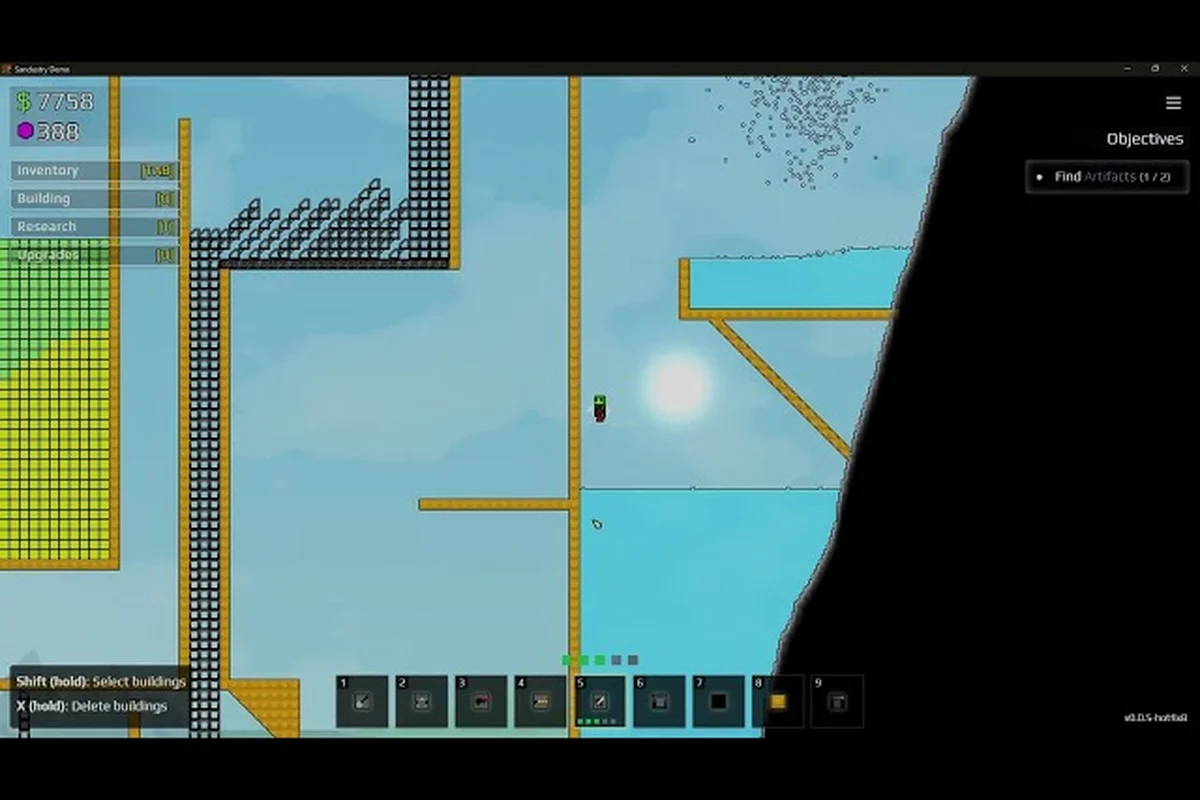
Ice in Sandustry isn't just a decorative block — it's a primary water source that can sustain your entire factory once you understand the melting mechanics. This Sandustry how to melt ice guide walks you through the flamethrower method, explains the physics behind the phase change, and shows you how to route the resulting water into production lines. Because every pixel in Sandustry simulates independently, ice chips melt one by one, which means heat placement matters just as much as heat output.
The official Steam page confirms the core loop: ice melts to water, water boils to steam that rises and condenses into rain, while sand absorbs surrounding water and depletes reservoirs. That single sentence describes a full water cycle you can exploit. If you've been struggling with dry spells or wondering why your reservoirs keep emptying, learning to melt ice efficiently will solve both problems at once. Get ready to turn frozen blocks into the lifeblood of your operation.
Why Melting Ice Matters for Your Sandustry Materials Economy
Water sits at the center of nearly every production chain in Sandustry, which makes melting ice one of the most valuable skills you can learn early. Without a reliable water supply, you cannot grow seeds, process slag, or maintain the steam systems that power advanced machinery. The game's pixel simulation means water doesn't just appear — it has to come from somewhere, and ice is the most abundant frozen resource on the map.
Ice chips behave independently in the simulation, so a single flamethrower blast can melt dozens of pixels at different rates depending on distance and heat intensity. This creates a natural gradient: ice closest to the flame turns to water first, while pixels further away take longer. Understanding this gradient lets you design melting chambers that produce a steady stream of water rather than a sudden flood.
The water cycle in Sandustry doesn't stop at melting, because boiling water produces steam that rises and condenses into rain — a process the developers highlighted in their simulation rewrite video on YouTube. That means you can create closed-loop systems where melted ice becomes steam, steam becomes rain, and rain refills your collection pools. Players who master this loop rarely worry about water shortages again.
Sandustry resource locations for ice are predictable once you know what to look for. Snow-covered biomes and cold regions generate ice chips naturally, while colder underground caves often contain dense ice deposits that are perfect for large-scale melting operations. The official Sandustry website describes how snow, seeds, spores, and ice chips each simulate independently, which explains why some ice patches melt faster than others based on surrounding pixel interactions.
Setting Up Your First Flamethrower Melting Station
Before you can melt ice efficiently, you need the right tools and a clear understanding of how heat transfers through the pixel grid. The flamethrower is the most direct option, but its placement relative to the ice determines how quickly you get usable water.
Choosing the Right Heat Source
| Heat Source | Melting Speed | Fuel Cost | Best Use Case |
|---|---|---|---|
| Flamethrower | Fast | Medium | Direct melting of ice blocks |
| Lava Contact | Very Fast | Free | Natural melting near volcanic zones |
| Steam Vent | Slow | Low | Passive melting for small pools |
| Heated Sand | Slow | Low | Indirect melting through thermal transfer |
The flamethrower remains the most reliable choice for controlled melting because you can aim it precisely and stop the heat the moment you have enough water. Lava contact melts faster but offers no control, which often leads to flooding. Steam vents work well for passive setups but take too long when you need water quickly.
Your melting station layout matters more than the heat source itself. Position the flamethrower so its cone covers the widest cross-section of the ice block, because pixel-level simulation means each ice chip absorbs heat individually. A narrow flame melts a narrow channel; a wide flame melts a wide section. For maximum efficiency, place the flamethrower at a 45-degree angle so the heat spreads across multiple rows of ice chips simultaneously.
Water collection is the second half of the equation. Melted ice becomes liquid water pixels that obey gravity, so you need a collection channel below the melting area. Build a sloped floor that funnels water into a reservoir or directly into your production pipes. Players who skip this step end up with water spreading across the floor and evaporating before they can use it.
Fuel Management for Continuous Operation
Flamethrowers consume fuel continuously while active, which means you need a sustainable fuel supply before you start large-scale melting operations. The fuel-to-water conversion ratio depends on the ice density in your chosen location, so test your setup on a small ice patch first to measure output.
| Fuel Type | Burn Time | Water Yield per Tank | Notes |
|---|---|---|---|
| Basic Fuel | 60 seconds | ~40 units | Good for testing |
| Refined Fuel | 90 seconds | ~65 units | Better efficiency |
| Slag Fuel | 120 seconds | ~80 units | Requires slag processing |
According to community reports, slag can be burned and processed further, which makes it a viable fuel source once you have the right infrastructure. The Sandustry simulation rewrite video shows how the developers reworked water flow and steam behavior, which directly affects how melted ice behaves in your collection system.
Where to Find Ice and Other Key Sandustry Materials
Knowing how to melt ice is only half the battle — you also need to know where the best ice deposits are located. Sandustry resource locations vary by biome, and some areas offer much denser ice concentrations than others. The biome list on this site breaks down the full world layout, but here are the key zones for ice farming.
Ice-Rich Zones and What Else They Offer
| Biome | Ice Density | Additional Materials | Risk Level |
|---|---|---|---|
| Snow Fields | High | Seeds, Snow | Low |
| Frozen Caves | Very High | Gold, Slag | Medium |
| Glacier Edge | Medium | Sand, Ice | Low |
| Tundra Depths | High | Spores, Minerals | High |
The frozen caves deserve special attention because they combine dense ice deposits with valuable minerals. If you're wondering where to find gold in Sandustry, these caves often contain gold veins embedded in the ice walls. Melting the ice reveals the ore underneath, which makes your melting operation doubly profitable.
Sandustry all materials follow a biome-based distribution pattern, so planning your resource gathering around biome types saves significant time. The biome list guide covers the complete world layout, including secret areas that contain rare materials. Players who explore thoroughly often find ice caves that connect to larger underground networks.
Sandustry material farming guide strategies usually recommend starting with snow fields because they offer low-risk ice collection with minimal enemy presence. Once you have a steady water supply, you can expand into frozen caves where the real treasures lie. The gold veins in frozen caves are particularly valuable because they appear in concentrated clusters rather than scattered single pixels.
Building a Complete Water Production Pipeline
A single flamethrower melting ice into a pool works fine for early game, but scaling up requires a proper pipeline. The water production pipeline connects melting stations to storage, then routes water to wherever your factory needs it. This section covers the full flow from ice block to usable resource.
Step-by-Step Pipeline Construction
-
Step 1: Survey the Ice Deposit — Measure the ice block dimensions and note the surrounding terrain. Larger deposits support longer melting sessions without refueling.
-
Step 2: Build the Collection Channel — Dig a sloped channel below the ice that funnels melted water toward your reservoir. The slope should be steep enough for water to flow but gentle enough to prevent splashing.
-
Step 3: Position the Flamethrower — Place it at the optimal angle for maximum heat coverage. Test different positions to find the sweet spot where ice melts fastest without wasting fuel.
-
Step 4: Connect Storage Tanks — Route the collection channel into storage tanks or directly into production pipes. Multiple tanks prevent overflow during high-output melting sessions.
-
Step 5: Monitor and Adjust — Watch the melting rate and adjust flamethrower positioning as the ice block shrinks. The heat gradient shifts as ice pixels disappear, so you may need to reposition mid-operation.
The steam recovery loop adds another layer of efficiency to your pipeline. When water boils, the resulting steam rises and condenses into rain, which you can collect with overhead structures. The official Sandustry Steam page confirms that steam rises and condenses into rain, so this isn't speculation — it's a documented game mechanic.
Automation Notes for Melting Lines
Manual flamethrower operation works for small setups, but automation becomes necessary as your factory grows. Timer-based flamethrower activation lets you melt ice in controlled bursts, preventing overflow while maintaining a steady water supply. Some players use pressure plates that trigger the flamethrower when water levels drop below a threshold.
| Automation Method | Complexity | Reliability | Best For |
|---|---|---|---|
| Manual Control | Low | High | Early game |
| Timer Activation | Medium | Medium | Mid game |
| Pressure Plate | High | High | Late game |
The pressure plate method offers the best reliability because it responds to actual water levels rather than fixed time intervals. However, it requires more complex wiring and careful calibration. Start with timers and upgrade to pressure plates once you understand your factory's water consumption patterns.
Advanced Melting Techniques and Optimization
Once you master basic melting, several advanced techniques can dramatically improve your water output and material efficiency. These strategies come from experienced players who have spent hundreds of hours optimizing their melting operations.
Thermal Cascading for Faster Melting
Thermal cascading uses the heat from already-melted water to accelerate the melting of adjacent ice. Because water pixels retain heat, they transfer that warmth to nearby ice chips, creating a chain reaction that melts ice faster than a flamethrower alone. Set up your melting station so water pools against the ice face, allowing the heated water to do some of the work.
The heat retention properties of water in Sandustry make this technique particularly effective in enclosed spaces. Caves trap heat better than open fields, which is why frozen caves produce water faster than surface snow fields. If you're melting ice for large-scale production, prioritize cave locations over surface deposits.
Multi-Station Melting Arrays
| Array Type | Stations | Output Rate | Space Required |
|---|---|---|---|
| Linear Array | 3-4 | Medium | Small |
| Grid Array | 6-8 | High | Large |
| Vertical Stack | 4-5 | Very High | Medium |
A grid array of flamethrowers positioned around a large ice block can melt the entire deposit simultaneously, cutting processing time by more than half. The tradeoff is fuel consumption — more flamethrowers mean more fuel burned per minute. Balance your fuel production against your melting speed to find the optimal configuration.
Vertical stacking takes advantage of gravity by placing flamethrowers at different heights, melting ice from multiple angles simultaneously. This approach works best in caves with tall ice formations, where a single flamethrower can only reach part of the deposit.
Integrating with Gold and Mineral Extraction
The frozen cave connection between ice and gold makes melting an essential step in your mineral extraction process. When you melt ice that surrounds gold veins, the exposed ore becomes accessible for collection. This dual-purpose melting saves time because you're producing water and revealing minerals in a single operation.
If you're focused on Sandustry where to find gold, the gold guide covers the complete extraction process, including which ice formations typically hide the richest veins. Combined with the raw materials guide, you'll have a complete picture of how melting ice feeds into your broader material economy.
Frequently Asked Questions
How long does it take to melt ice with a flamethrower in Sandustry?
A standard flamethrower melts a medium-sized ice block in roughly 20-30 seconds, depending on distance and angle. Positioning the flame at a 45-degree angle for maximum coverage speeds up the process significantly. Larger deposits take proportionally longer, so plan your melting sessions accordingly.
Can I melt ice without a flamethrower?
Yes, you can use lava contact, steam vents, or heated sand as alternative heat sources. Lava melts ice fastest but offers no control, while steam vents provide slow passive melting. Heated sand works through thermal transfer but requires pre-heating. Each method has tradeoffs in speed, control, and fuel cost.
What happens to the water after ice melts?
Melted ice becomes water pixels that obey gravity and flow downhill. You can collect this water in reservoirs, route it into production pipes, or let it pool naturally. If the water boils, it becomes steam that rises and condenses into rain, which you can collect with overhead structures.
Where is the best place to find ice for melting?
Snow fields offer the safest ice collection with minimal risk, while frozen caves provide denser deposits alongside valuable minerals like gold and slag. Glacier edges offer medium density with easy access. The best location depends on your current stage of progression and what materials you need.
Does melting ice help with gold extraction?
Yes—melting ice in Sandustry exposes gold ore trapped inside frozen caves. Aim your torch or heat source at ice walls to reveal veins, then collect the ore. Bonus: the meltwater refills reservoirs, so you’re mining and hydrating simultaneously. Try a steam loop for efficiency, or keep it simple with a bucket.