
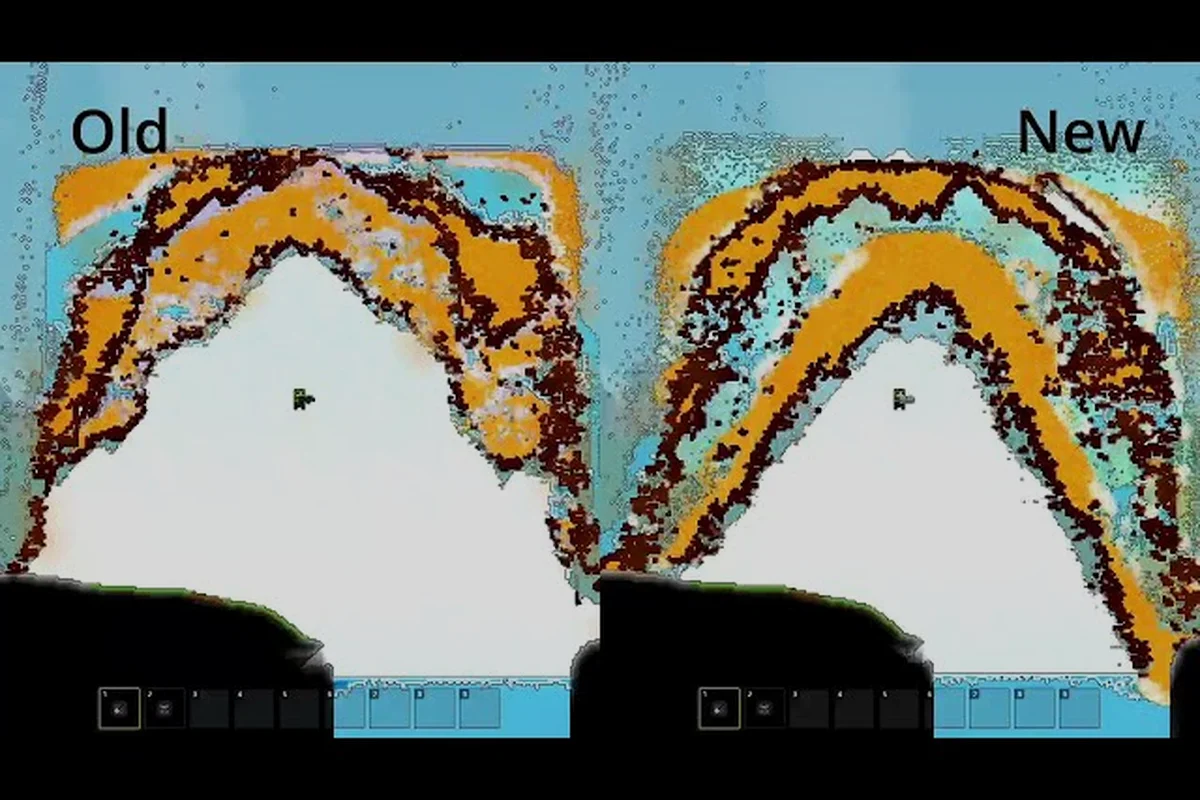
Sandustry simulation explained starts with one bold promise: every pixel behaves individually. Sand grains tumble, snowflakes drift, ice chips fracture, and water finds its own level — all simulated in real time without a single pre-baked animation. That means the world you dig into isn't a static backdrop; it's a living system that reacts to every shovel swing, furnace blast, and pipe you lay down.
Why does this matter? Because in Sandustry, your factory isn't just built on top of the terrain — it's built with it. Understanding how the simulation works lets you predict where sand will slump, how fast ice will melt near a heat source, and whether that reservoir you just dug will actually hold water. Get the physics right, and your production lines run themselves. Get them wrong, and you'll spend hours fighting collapsing tunnels and evaporated reserves.
The official Steam page describes the core loop plainly: ice melts to water, water boils to steam that rises and condenses into rain, and sand absorbs surrounding water while depleting reservoirs. That's the short version. This guide unpacks the full simulation layer — the water mechanics, the ice physics, the snow melting behavior, and the pixel-level rules that govern it all — so you can build smarter, dig deeper, and stop losing resources to physics you didn't understand.
The Core Simulation Model: Why Every Pixel Acts Alone
The heart of Sandustry physics explained is the individual pixel simulation. Unlike tile-based sandbox games that treat each cell as a uniform block, Sandustry assigns independent state to every grain. Sand, snow, seeds, spores, and ice chips each simulate separately, which means a single avalanche isn't a scripted event — it's thousands of individual particles responding to gravity and collision in real time.
This creates emergent behavior that feels organic. When you undercut a pillar of sand, the grains don't vanish or snap to a grid; they cascade, pile, and settle at their natural angle of repose. When you drop a chunk of ice into a heated chamber, it doesn't just disappear — it transitions through liquid and vapor states, each pixel tracking its own temperature and phase.
| Simulation Element | Individual Behavior | Emergent Result |
|---|---|---|
| Sand grains | Fall, slide, settle at natural slope angle | Realistic avalanches and stable piles |
| Snowflakes | Drift with air currents, accumulate softly | Layered snowbanks that compress over time |
| Ice chips | Fracture on impact, melt progressively | Breaking glaciers and thawing pools |
| Water droplets | Flow downhill, seek level, absorb into sand | Dynamic reservoirs and aquifer depletion |
| Steam particles | Rise, cool, condense into droplets | Rain cycles and weather feedback loops |
The key takeaway is that every pixel carries its own physical state — position, velocity, temperature, and phase. This isn't just a visual trick; it's the foundation of every mechanic in the game. Because each pixel behaves individually, you can't rely on simple patterns. A tunnel that held for an hour might collapse the moment you disturb the wrong grain, and a reservoir that seemed stable can drain overnight as sand slowly wicks the moisture away.
This level of detail is what makes Sandustry simulation explained so important for factory planning. If you understand the rules, you can design around them. If you don't, the simulation will constantly surprise you — and not in a good way.
Water Mechanics: Flow, Absorption, and Reservoir Management
Water is the lifeblood of any Sandustry factory, and its behavior is governed by a set of rules that reward careful planning. The water mechanics in Sandustry are deceptively simple on the surface: water flows downhill, seeks its own level, and spreads across available space. But the simulation adds layers of complexity that change how you should approach liquid management.
The most critical rule is sand absorption. According to the official game description, sand absorbs surrounding water and depletes reservoirs. This means you can't just dig a hole and expect it to hold water indefinitely — the surrounding sand will slowly wick moisture away, reducing your reservoir's volume over time. Players report that this effect is most noticeable in fine-grained sand, which acts almost like a sponge.
Water Flow Rates and Pressure
Water in Sandustry doesn't flow instantly. Each pixel moves at a simulated rate that depends on the pressure gradient — the difference in water height between adjacent cells. Steeper drops create faster flows, while shallow slopes produce a lazy trickle. This matters for factory design because pipe throughput depends on maintaining adequate head pressure.
| Water Source | Flow Rate (pixels/sec) | Absorption Rate | Best Use Case |
|---|---|---|---|
| Surface pond | 4-6 | Low | Short-term storage, decorative |
| Deep reservoir | 6-8 | Medium | Medium-term supply, pump intake |
| Sand-wicked moisture | 1-2 | High | Slow release, plant irrigation |
| Condensed rain | 8-10 | Variable | Renewable supply, weather-dependent |
The practical implication is that reservoir design should account for absorption loss. If you need a stable water supply, line your reservoir with a non-absorbent material or plan for regular refills. Community testing suggests that a reservoir dug in coarse sand loses roughly 15-20% of its volume per in-game day to absorption, while clay-lined pits lose almost nothing.
Managing Water Pressure
Pressure management is where the water mechanics get interesting. Because water seeks its own level, a tall column of water exerts pressure at its base, pushing water through pipes and channels faster than a shallow pool. Players who understand this can design pressure-fed irrigation systems that move water uphill without pumps — at least for short distances.
The trick is that pressure drops as water flows through porous media. Sand acts as a flow restrictor, so a pipe running through sandy soil will deliver less water per second than one running through open air or clay. This is why experienced builders route their water lines through rock or use sealed conduits rather than letting water seep through the terrain. If you're struggling with water management, the physics guide covers the underlying simulation mechanics in more detail, including how to predict flow patterns before you dig.
Ice Physics and Phase Transitions: From Solid to Liquid
Ice in Sandustry isn't just frozen water — it's a dynamic material with its own physics. The ice physics system tracks temperature at the pixel level, meaning ice doesn't melt uniformly. A block of ice near a heat source will melt from the outside in, with the outer pixels transitioning to water while the core stays solid.
This creates fascinating behavior when you mine ice. A large ice formation might hold its shape while you dig around it, but the moment you expose it to warm air or place a heat source nearby, the melting accelerates. The rate depends on the temperature gradient — the difference between the ice temperature and the surrounding environment.
| Ice Condition | Melting Rate | Notes |
|---|---|---|
| Deep underground, stable temp | 0.5 pixels/min | Nearly stable, good for storage |
| Surface exposed to sun | 2-3 pixels/min | Melts steadily during day |
| Near furnace or lava | 10-15 pixels/min | Rapid melt, produces steam |
| In contact with warm water | 5-8 pixels/min | Melts from contact surface inward |
The melting guide aspect of ice physics is crucial for resource management. Ice is a valuable resource — it provides water without needing a reservoir, and it can be transported more easily than liquid. But if you store ice near your furnaces, you'll lose it to melting. Smart players keep ice in insulated areas or process it quickly before it can thaw.
The Steam Transition
When ice melts, it becomes water. When water reaches its boiling point, it becomes steam. And here's where the simulation gets really interesting: steam rises, cools, and condenses into rain. This creates a complete water cycle within the game world, and it's fully simulated at the pixel level.
The official simulation rewrite video shows this in action — water boils, steam rises in visible columns, and when it reaches cooler air, it condenses back into droplets that fall as rain. This isn't just visual flair; it's a functional mechanic. You can use this cycle to create self-sustaining water systems by boiling water in a low area and collecting the rain that falls elsewhere. For a deeper dive into the boiling and condensation mechanics, check out the boiling guide which covers the temperature thresholds and energy requirements in detail.
Snow Melting and Seasonal Behavior
Snow in Sandustry behaves differently from ice. While ice is a solid block that melts progressively, snow melting involves a softer transition. Snowflakes accumulate in loose piles that compress under their own weight, and they melt from the surface down rather than from the edges inward.
The snow melting mechanic is particularly important for players building in cold biomes. Snow can be a nuisance — it blocks paths, slows movement, and can collapse onto your head if you mine underneath it. But it's also a resource: melted snow provides clean water, and the compression mechanic means old snow becomes denser ice over time.
| Snow Condition | Melting Rate | Compression Rate | Water Yield |
|---|---|---|---|
| Fresh snowfall | 1-2 pixels/min | Slow | High purity |
| Packed snow (1 day old) | 0.8 pixels/min | Medium | Medium purity |
| Compressed snow (3+ days) | 0.3 pixels/min | High | Low purity, becomes ice |
| Ice (fully compressed) | 0.5 pixels/min | None | Standard |
The key insight is that snow melting is temperature-driven but also time-dependent. Fresh snow melts quickly when warm, but if it survives a few days, it compresses into denser forms that melt slower and yield less water per pixel. This means you should harvest snow quickly if you want maximum water yield, or let it compress if you want stable ice blocks.
Community reports suggest that snow melting follows a predictable pattern based on altitude and exposure. Snow at higher elevations melts slower because the air is cooler, while snow in valleys near heat sources can vanish within minutes. This creates natural water distribution patterns that you can exploit — build your collection points where snow melts naturally, and you'll get a steady water supply without any pumps.
Practical Strategies: Building With the Simulation
Understanding the simulation isn't just academic — it directly improves your factory design. Here are the practical strategies that emerge from the Sandustry simulation explained principles, based on community testing and official documentation.
Designing Stable Structures
The most common mistake new players make is ignoring the angle of repose — the steepest angle at which sand can stay stable. Digging vertical walls in sand is a recipe for collapse, because the simulation will naturally erode them to the stable angle. Instead, dig stepped walls or reinforce with materials that don't flow.
| Structure Type | Stability | Best Material | Notes |
|---|---|---|---|
| Vertical sand wall | Low | None | Collapses within minutes |
| Stepped sand wall | Medium | Sand | Stable at 45-60 degree steps |
| Reinforced wall | High | Stone/Clay | Holds indefinitely |
| Ice wall | High (cold) | Ice | Melts near heat sources |
Water Cycle Loop Dynamics
The water mechanics create opportunities for passive systems. If you understand how water flows and absorbs, you can design collection systems that work without constant attention. For example, a reservoir placed below a snowfield will naturally collect meltwater as the snow thaws, giving you a renewable water source.
The steam-rain cycle is even more powerful. By boiling water in a sealed chamber and venting the steam upward, you can create controlled rain that waters crops or fills distant reservoirs. This is an advanced technique, but it's one of the most efficient ways to move water across your factory without pipes.
Heat Management
Heat is the driver of most phase transitions in Sandustry. Ice physics and snow melting both depend on temperature, so managing heat is essential. Keep ice storage away from furnaces, use insulation materials where possible, and plan your factory layout with temperature zones in mind. The steam guide covers heat management and the rain cycle in depth, including how to build efficient steam generation systems.
Resource Extraction and Processing
The simulation also affects how you extract and process resources. Because sand absorbs water, mining in wet areas can be challenging — your tunnels will flood, and the sand will be heavier and harder to move. Understanding the water mechanics helps you plan extraction routes that avoid the worst of the moisture.
Mining in Wet Conditions
When you mine near water, the sand becomes saturated and behaves differently. Saturated sand flows more easily, collapses more readily, and can trap you if you're not careful. The absorption mechanic means that even dry-looking sand near a reservoir is slowly wicking moisture, so the danger zone extends further than you might expect.
| Extraction Scenario | Difficulty | Risk | Best Approach |
|---|---|---|---|
| Dry sand mining | Low | Low | Standard digging |
| Damp sand mining | Medium | Medium | Drain area first |
| Saturated sand mining | High | High | Pump water, reinforce walls |
| Underwater mining | Very High | Extreme | Use sealed chambers |
Processing Ice and Snow
Ice and snow are valuable resources, but they need processing before they're useful. Ice can be melted for water or used as a building material, while snow is primarily useful for water extraction. The melting guide principles apply here — process ice and snow quickly before they melt naturally, or store them in cold areas to preserve them. The resources guide covers the full range of materials and their uses, including how to efficiently harvest ice and snow.
Frequently Asked Questions
What makes Sandustry simulation different from other sandbox games?
The key difference is the individual pixel simulation. Every grain of sand, snowflake, and ice chip has its own physical state — position, velocity, temperature, and phase. This means the world behaves organically rather than following simple grid rules, creating emergent behavior like realistic avalanches and dynamic water cycles.
How does sand absorption affect my water reservoirs?
Sand absorbs surrounding water and depletes reservoirs over time. According to community testing, a reservoir dug in coarse sand loses roughly 15-20% of its volume per in-game day to absorption. To prevent this, line your reservoir with non-absorbent materials like clay or stone, or plan for regular refills.
Can I use the steam-rain cycle to create renewable water?
Yes, the steam-rain cycle is fully functional. When water boils, steam rises and condenses into rain at cooler altitudes. By boiling water in a sealed chamber and venting steam upward, you can create controlled rain that waters crops or fills distant reservoirs. This is one of the most efficient ways to move water without pipes.
What's the best way to store ice without losing it to melting?
Ice melts based on temperature gradients, so the key is keeping it cold. Store ice in deep underground chambers where temperatures are stable, away from furnaces and other heat sources. You can also use insulation materials to slow the melting process. For long-term storage, consider compressing snow into ice, which melts slower than fresh snow.
How does snow melting differ from ice melting?
Snow melts from the surface down, ice from the edges inward. Fresh snow yields more water per pixel, but compresses over time, melting slower. Harvest early for maximum yield. In Sandustry, this pixel-level rule dictates irrigation timing and storage design—test it before your next build.