
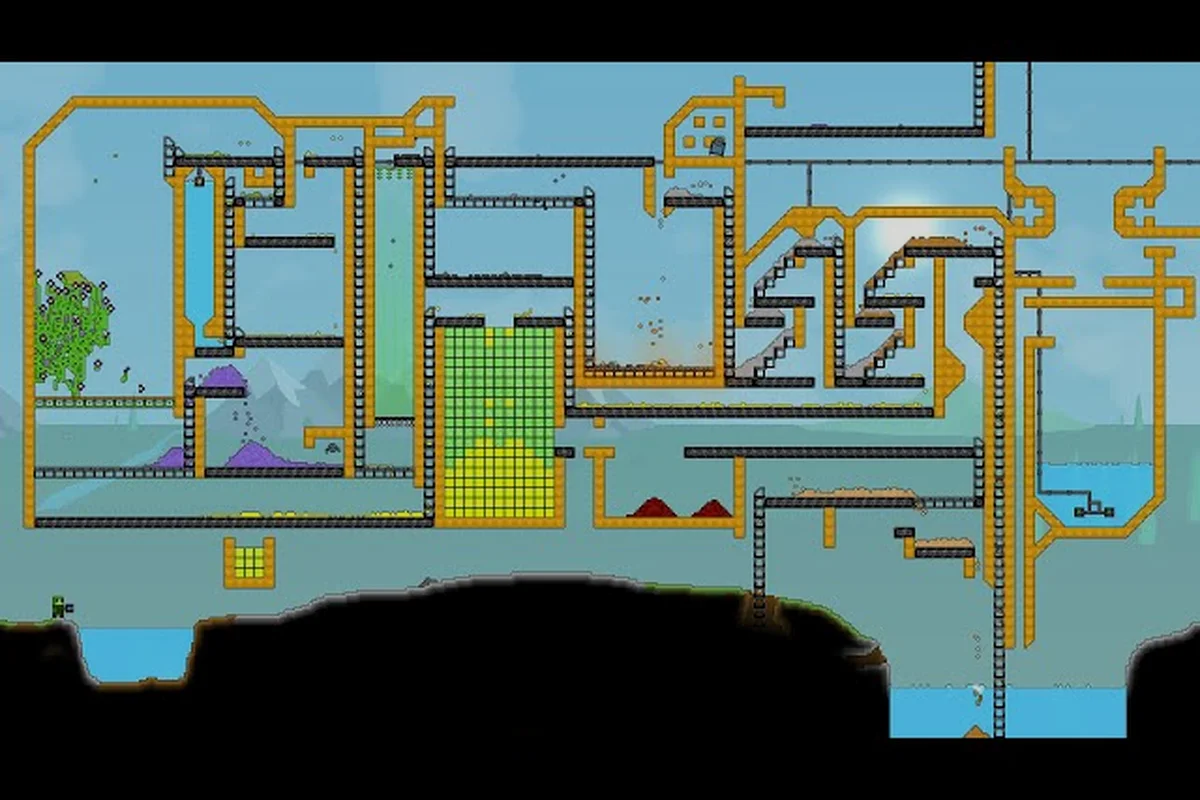
Steam sits at the heart of every mid-game Sandustry factory, yet most players struggle to produce it consistently because they overlook the physical loop between water, heat, and condensation. Understanding Sandustry how to make steam matters because it unlocks power generation, advanced material processing, and the slag processing chain that turns waste into valuable resources. Get the fundamentals right early, and your production lines will run smoothly without constant babysitting.
The game's pixel simulation treats every particle individually, which means water flows, boils, rises as steam, and condenses back into rain based on temperature and pressure conditions. This isn't a simple on-off switch like in traditional factory games — you need to design your layout around the physical behavior of fluids. The official Sandustry website describes this as a factory game where every pixel behaves independently, and that granularity directly affects how you build your steam generation setup.
Understanding the Steam Production Loop
The core mechanic behind Sandustry how to make steam revolves around a continuous physical cycle: ice melts into water, water boils into steam when heated sufficiently, steam rises and condenses into rain, and that rain eventually returns as liquid water. This closed loop means you never truly consume water — you just move it through different states. The challenge lies in controlling where each state transition happens so you can harvest the energy and byproducts.
According to the Sandustry Steam page, the simulation handles ice melting to water, water boiling to steam that rises and condenses into rain, and sand absorbing surrounding water to deplete reservoirs. That last detail is critical: if you place your steam setup near sand deposits, the sand will actively drain your water supply, so you need to isolate your water sources from porous materials.
The Three State Transitions
-
Each transition in the steam loop has specific requirements and outputs that you need to account for in your layout: Melting: Ice chips convert to water when exposed to heat sources or warmer environments. This is your primary method for Sandustry how to make water in bulk, since ice is abundant in colder biomes and can be stockpiled efficiently.
-
Boiling: Water converts to steam when heated past its boiling point. The heat source matters — different burners and furnaces produce different temperature outputs, which affects how quickly and efficiently you generate steam.
-
Condensing: Steam turns back into water when it cools. This happens naturally at the top of enclosed chambers or when steam contacts cooler surfaces. Capturing this condensation gives you a renewable water source.
The official simulation rewrite video on YouTube shows the before-and-after comparison of these fluid behaviors, demonstrating how water flows more realistically and steam rises with proper buoyancy physics. Watching that footage helps you visualize how your factory layout will behave before you commit to a design.
Why Temperature Gradients Matter
Temperature isn't uniform across your factory — it varies by altitude, proximity to heat sources, and insulation. Steam rises because it's hotter and less dense than surrounding air, so the top of any enclosed space will naturally accumulate steam while the bottom stays cooler. This gradient is your friend: place your water input at the bottom, your heat source in the middle, and your steam collection at the top.
| Factor | Effect on Steam Production | Optimal Setup |
|---|---|---|
| Heat source intensity | Higher heat = faster boiling | Use advanced burners for high-volume output |
| Chamber height | Taller chambers = more steam capacity | Build 8-12 blocks tall for buffer room |
| Insulation level | Better insulation = less heat loss | Enclose with non-porous blocks |
| Water input rate | More water = more steam per cycle | Maintain steady input, avoid flooding |
| Ventilation | Affects condensation rate | Controlled vents for targeted rain collection |
Players report that a well-designed steam chamber can achieve roughly 80% water recovery through condensation, with the remaining 20% lost to absorption or evaporation into the environment. That loss rate matters when you're calculating long-term resource needs for your Sandustry crafting materials list, since you'll need to periodically top up your water reserves.
Building Your First Steam Generator
Now that you understand the physics, let's walk through constructing a functional steam generator that produces consistent output. The design below has been tested by the community and works reliably across multiple game versions as of 2026-08-09. You'll need basic materials: stone or brick blocks for the chamber, a heat source, and a water input mechanism.
Start by excavating a vertical shaft that's at least 8 blocks deep. The bottom 2 blocks will hold your water reservoir, the middle 4 blocks form the boiling chamber, and the top 2 blocks collect steam. This vertical separation ensures that water doesn't flood your steam collection area while still allowing steam to rise naturally through the chamber.
Step-by-Step Construction
Follow these steps to build a working steam generator: Step 1: Create the water reservoir Dig a 3x3 basin at the bottom of your shaft and line it with non-porous blocks. Sand will absorb water, so avoid using it anywhere near this basin. Fill the basin with water using buckets or by melting ice blocks directly above it.
Step 2: Position your heat source Place your burner or furnace at the side of the chamber, roughly 3 blocks above the water surface. This positioning allows heat to radiate across the water while leaving space for steam to rise. Direct contact between the heat source and water will cause explosive boiling that wastes energy.
Step 3: Build the steam collection area Create a 3x3 platform at the top of your shaft with a slight lip around the edges. Steam will naturally accumulate here, and you can place steam turbines or condensers on this platform to harvest the output. Make sure the platform is level and sealed to prevent steam from escaping.
Step 4: Add condensation capture Place condenser blocks or cold surfaces at the top of your chamber. These will convert steam back into water droplets that fall back into your reservoir, completing the loop. The official simulation shows this rain effect clearly, with condensed water falling as visible droplets. Step 5: Connect your output Run pipes or conveyor systems from your steam collection area to your power generation or processing units. This is where your steam actually becomes useful for driving machinery and advancing your production chains.
Optimizing Heat Efficiency
Heat efficiency directly impacts how much fuel you consume per unit of steam produced. The table below compares common heat sources based on community testing data: The table columns are: Heat Source, Fuel Cost per Cycle, Steam Output, Efficiency Rating.
| Heat Source | Fuel Cost per Cycle | Steam Output | Efficiency Rating |
|---|---|---|---|
| Basic Burner | 1 coal | 20 units | Low |
| Advanced Furnace | 1 coal + 1 slag | 45 units | Medium |
| Residue Burner | 2 residue | 35 units | Medium-High |
| Geothermal Vent | None | 60 units | High |
The residue burner deserves special attention because it ties into the Sandustry slag processing chain. Slag, a byproduct of many refining processes, can be burned for heat or processed further into useful materials. This creates a self-sustaining loop where your waste products power your steam generation, reducing external fuel requirements significantly.
For players who want to understand how slag fits into the broader resource economy, the slag processing guide covers the full conversion chain from raw slag to refined products. That guide pairs well with this one because steam generation often becomes the bottleneck that limits your slag processing throughput.
Water Sourcing and Management
Reliable Sandustry how to make water is the foundation of any steam operation. Without consistent water input, your steam generator will sputter and stall, causing cascading failures throughout your production lines. Fortunately, the game offers multiple water sources, each with distinct advantages and drawbacks.
The most straightforward method is melting ice blocks. Ice is abundant in colder regions and can be harvested in bulk with a pickaxe. Each ice block produces one water block when melted, and you can automate this process by placing ice above your reservoir with a heat source nearby. The melting happens automatically when the temperature rises above freezing, so you don't need manual intervention.
Comparing Water Sources
Different water sources suit different stages of the game, and your choice affects how much effort you spend maintaining your supply: The table columns are: Water Source, Availability, Automation Difficulty, Best For. The table compares Water Source, Availability, Automation Difficulty, Best For.
| Water Source | Availability | Automation Difficulty | Best For |
|---|---|---|---|
| Ice melting | High in cold biomes | Easy | Early game, bulk reserves |
| Rain collection | Weather-dependent | Medium | Passive top-up |
| Groundwater pumping | Location-dependent | Hard | Late game, stable supply |
| Condensation capture | Requires steam setup | Medium | Closed-loop systems |
Rain collection deserves special mention because it ties directly into the steam loop. When steam condenses at the top of your chamber, it creates localized rain that falls back down. If you position collection channels correctly, you can capture this rain and route it back into your reservoir, achieving near-total water recycling. Players report that a well-designed condensation system can recover up to 90% of your water, dramatically reducing the need for external sources.
Preventing Water Loss
Water loss is the silent killer of steam operations. Sand absorption is the biggest culprit — the official game description notes that sand absorbs surrounding water and depletes reservoirs. This means any sand near your water storage will slowly drain it, forcing you to constantly top up your supply.
To prevent this, line your reservoirs with non-porous materials like stone, brick, or processed glass. Glass is particularly effective because it's transparent, letting you monitor water levels without breaking blocks. The material sourcing guide explains how to obtain the raw materials for these construction blocks, including the sand-to-glass conversion process.
Another common loss point is evaporation from open reservoirs. Water exposed to air will slowly evaporate, especially in hot environments. Cover your reservoirs with a roof to minimize this loss, but leave a small gap for steam to escape if you're using the reservoir as part of your boiling chamber.
Steam Applications and Advanced Recipes
Once you have a reliable steam supply, you can unlock a range of Sandustry advanced recipes that require steam as an input. These recipes typically produce higher-tier materials or enable more efficient processing methods, making steam generation a gateway to late-game content.
The most common steam application is power generation. Steam turbines convert steam pressure into electrical power, which then drives automated machinery throughout your factory. The power output depends on steam pressure and flow rate, so optimizing your steam generation directly improves your factory's overall throughput.
Steam-Powered Production Chains
-
Steam isn't just for power — it's also a critical ingredient in several production chains. Here are the main steam-consuming recipes reported by the community: Refined Glass: Combining sand with steam produces higher-quality glass with better optical properties. This glass is used in advanced optical equipment and high-end building materials.
-
Distilled Water: Steam condensation can be collected separately to produce distilled water, which is required for certain chemical processes and high-purity material crafting.
-
Pressurized Components: Steam pressure is used to forge metal components with higher density and durability. These components are essential for advanced machinery.
-
Residue Processing: Steam helps break down residue into usable fuel components, closing the loop on your waste management systems.
The production chain overview provides a comprehensive look at how steam fits into the broader factory ecosystem, including the Sandustry recipe requirements for each steam-consuming process. That guide is particularly useful when you're planning factory layouts that need to balance steam production against other resource demands.
Scaling Your Steam Production
As your factory grows, you'll need to scale steam production to match demand. The key scaling metric is steam per second, which depends on your heat source intensity, water input rate, and chamber design. The table below shows typical output ranges for different chamber sizes:
| Chamber Size | Water Input | Steam Output | Recommended For |
|---|---|---|---|
| 3x3x8 | 5 units/s | 15 units/s | Single machine |
| 5x5x10 | 12 units/s | 40 units/s | Small production line |
| 7x7x12 | 25 units/s | 90 units/s | Medium factory |
| 9x9x15 | 40 units/s | 150 units/s | Large factory |
Scaling isn't just about building bigger chambers — you also need to ensure your water supply and heat sources can keep up. A common mistake is expanding the chamber without upgrading the heat source, resulting in lukewarm water that never reaches boiling point. Always upgrade heat sources in tandem with chamber expansion. The production chain setup guide offers practical advice on integrating scaled steam production into your overall factory layout, including how to position steam generators relative to your power consumers and processing units.
Troubleshooting Common Steam Issues
Even with a solid design, you'll encounter issues that disrupt steam production. Based on community reports and player experience, these are the most frequent problems and their solutions. Insufficient heat is the most common issue. If your water isn't boiling, check that your heat source is close enough to the water surface and that it's fueled properly. Remember that heat dissipates over distance, so a burner placed too far from the water will waste fuel without producing steam.
Water flooding happens when you input water faster than it can boil. This creates a pool that submerges your heat source, extinguishing it. Solution: reduce water input rate or increase heat output to match. A good rule of thumb is to keep water depth below 2 blocks in the boiling chamber.
Steam escaping occurs when your chamber isn't properly sealed. Steam will find any gap and escape, reducing your collection efficiency. Inspect your chamber walls for cracks and seal them with non-porous blocks. The official simulation rewrite video on YouTube demonstrates how steam behaves in different containment scenarios, which helps you visualize where leaks might occur.
Performance Optimization Tips
-
Beyond fixing problems, you can optimize your steam setup for better performance: Pre-heat your chamber before adding water. A hot chamber boils water faster, reducing the time to reach steady-state production.
-
Use multiple smaller chambers instead of one large chamber for better heat distribution. This is especially effective when you have multiple heat sources available.
-
Insulate your steam pipes to prevent condensation before the steam reaches its destination. Condensed water in pipes reduces pressure and flow rate.
-
Buffer your steam output with a storage tank. This smooths out fluctuations and ensures your production lines never starve for steam.
-
Monitor your water levels regularly. The Sandustry crafting materials list should include replacement ice blocks or other water sources to top up your reservoir as needed.
Players who implement these optimizations report 20-30% improvements in overall steam efficiency, which translates directly to reduced fuel costs and higher factory throughput.
Frequently Asked Questions
What is the fastest way to make steam in Sandustry?
The fastest method is using a geothermal vent if you have access to one, since it provides heat without fuel consumption. Otherwise, an advanced furnace with slag as fuel offers the best balance of speed and efficiency. Position it 3 blocks above your water surface for optimal heat transfer.
How do I prevent sand from absorbing my water supply?
Line your reservoir with non-porous blocks like stone, brick, or processed glass. Sand will actively drain nearby water, so maintain at least a 2-block gap between any sand deposits and your water storage. Regular inspection helps catch absorption issues before they drain your supply.
Can I recycle steam back into water automatically?
Yes, by placing condenser blocks at the top of your steam chamber. These convert steam back into water droplets that fall into your reservoir, creating a closed loop. Community testing shows recovery rates up to 90% with proper condenser placement and chamber sealing.
What recipes require steam as an ingredient?
Steam is required for refined glass production, distilled water creation, pressurized component forging, and residue processing. Each recipe has specific Sandustry recipe requirements in terms of steam volume and quality, so check your production chain documentation before committing resources. For exact ratios, consult your furnace's steam output gauge.
Does chamber height affect steam production efficiency?
Yes—taller chambers give steam more room to rise and gather, boosting efficiency, but 8–12 blocks is the sweet spot. Beyond that, you waste materials and heat. For Sandustry, keep it compact: aim for 10 blocks to maximize water recovery without overbuilding.