
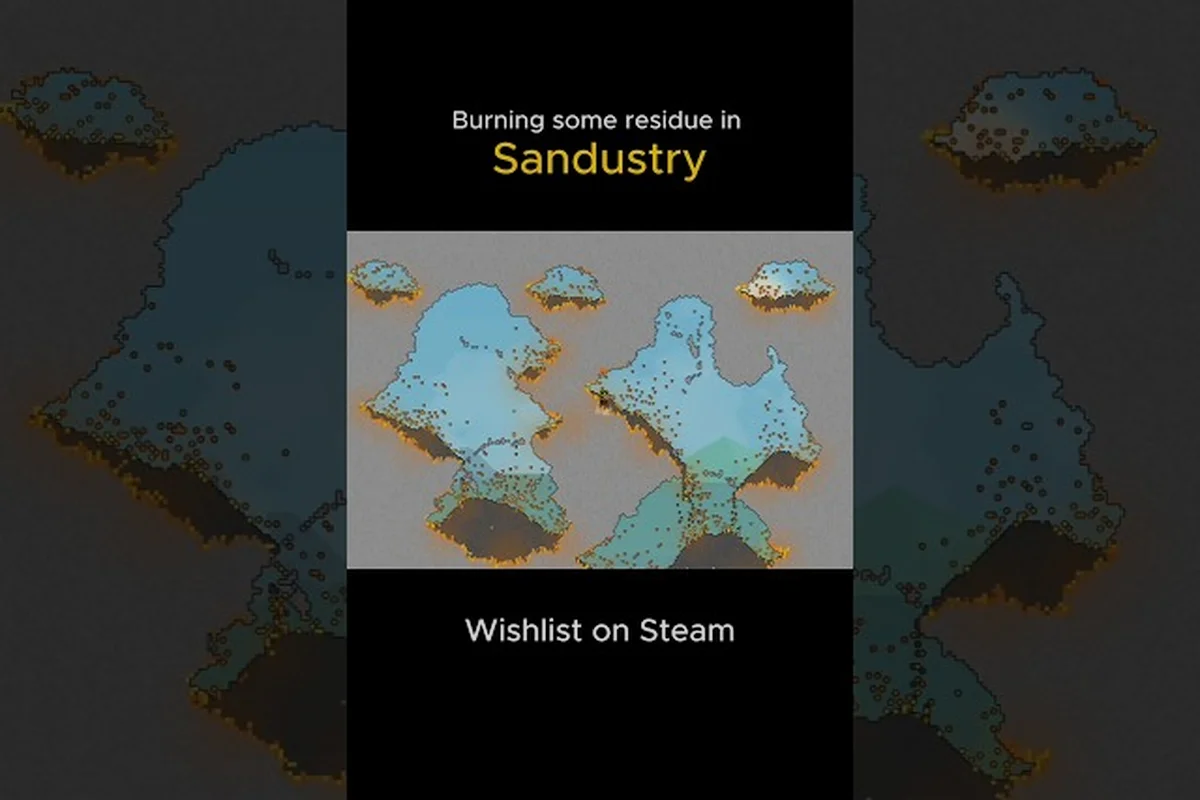
Sandustry temperature mechanics define how every pixel in the simulation responds to heat, cold, and phase changes, which makes them the backbone of any functional factory. Understanding these rules matters because your entire production chain depends on predicting whether water will freeze, ice will melt, or steam will condense at the right moment. Get the latest breakdown of how heat flows through the sandbox and what that means for your builds.
The simulation treats each pixel as an independent particle that exchanges temperature with its neighbors, creating emergent behavior that feels organic rather than scripted. When you pour water onto hot slag, the resulting steam rises and eventually cools back into rain, which then falls somewhere else entirely. This closed loop means your actions have consequences that ripple across the entire map, and mastering those ripples separates a functional factory from a chaotic mess.
Core Temperature States and Phase Transitions
Every element in Sandustry exists in one of several temperature states, and the transitions between them follow predictable rules that you can exploit. The official Steam page confirms that ice melts to water, water boils to steam, and steam rises and condenses into rain, which gives you a complete water cycle that operates entirely through temperature mechanics. These phase changes are not cosmetic animations; they physically move matter around the simulation grid.
The key insight is that each transition requires a specific temperature threshold, and the simulation tracks heat transfer between adjacent pixels continuously. When a hot pixel touches a cold pixel, they exchange energy until reaching equilibrium, which means you can create thermal gradients that drive production. The official Sandustry simulation rewrite video shows how water flows, ice melts, steam rises, and rain condenses in real time after the physics engine update.
| Phase Transition | Trigger Condition | Result | Typical Use Case |
|---|---|---|---|
| Ice to Water | Temperature rises above freezing point | Liquid water flows downward | Water reservoir refill |
| Water to Steam | Temperature reaches boiling point | Steam rises upward | Power generation |
| Steam to Rain | Steam cools at altitude | Rain falls as liquid water | Closed-loop water supply |
| Sand to Slag | Extreme heat from fire or lava | Molten material | Resource processing |
| Slag to Solid | Cooling over time | Hardened material | Building material |
The phase transition table above summarizes the five most important state changes you will encounter during normal play, and each one has practical applications beyond simple aesthetics. Community testing suggests that the exact temperature thresholds vary slightly depending on the surrounding elements, because thermal conductivity differs between sand, water, and air. This means a block of ice surrounded by sand melts faster than one surrounded by air, since sand conducts heat more efficiently.
How Heat Propagates Through Different Materials
Thermal conductivity is not uniform across all elements, and this creates interesting engineering challenges when you try to move heat where you need it. Sand conducts heat reasonably well, which is why burying hot objects in sand helps them cool faster, while water absorbs heat quickly but also distributes it evenly through convection. Air acts as an insulator, so gaps between elements slow down heat transfer significantly.
Players have reported that slag retains heat for a surprisingly long time, making it useful as a thermal battery that can keep nearby water boiling long after the initial heat source is removed. This property becomes valuable when you want to maintain steam production without constantly feeding fuel into a furnace. The tradeoff is that slag also radiates heat outward, which can accidentally melt ice reserves if you place them too close.
Sand Water Interaction and Absorption Mechanics
The sand water interaction is one of the most important temperature mechanics to understand because it affects both resource collection and factory layout. When sand comes into contact with water, it absorbs the moisture and depletes the surrounding reservoir, which the official Sandustry Steam page explicitly confirms. This absorption is not instant; it happens gradually as the simulation ticks, giving you a window to intervene if you notice your water supply disappearing.
The absorption rate depends on the type of sand and how much water is present, with finer sand absorbing faster than coarse grains. Community reports indicate that wet sand conducts heat differently than dry sand, which means a sand barrier that works for thermal insulation may fail once it becomes saturated. This creates a dynamic where your factory's thermal behavior changes over time as moisture migrates through the environment.
| Sand Type | Water Absorption Rate | Thermal Conductivity | Best Use |
|---|---|---|---|
| Fine Sand | Fast | Low | Filtering water |
| Coarse Sand | Slow | Medium | Thermal barrier |
| Wet Sand | Saturated | High | Heat distribution |
| Dry Sand | None | Low | Insulation |
| Slag Sand | None | Very High | Heat retention |
The absorption comparison table shows how different sand variants behave when exposed to water, and you should choose your building materials based on whether you want to retain or reject moisture. If you are building a water collection system, fine sand helps filter impurities, but if you are constructing a thermal barrier, coarse sand stays dry longer and insulates better. Understanding these differences lets you design factories that maintain stable temperatures even as water moves through the system.
Managing Water Reservoirs Near Heat Sources
Placing water reservoirs near furnaces or other heat sources creates a constant battle between evaporation and condensation, and you need to account for both directions of the cycle. When water boils, the steam rises and carries heat upward, which can create rain clouds that deposit water far from your original reservoir. This means your water supply can literally relocate itself over time if you do not manage the thermal environment carefully.
Players who have experimented with closed-loop systems report that positioning condensers above boilers creates a self-sustaining water cycle that requires minimal intervention. The steam rises, cools at altitude, condenses into rain, and falls back into the reservoir below, completing the loop without any pumps or pipes. This technique works best in enclosed spaces where the steam cannot escape, so building a sealed chamber around your boiler maximizes efficiency.
Ice to Water Conversion and Cold Management
The ice to water transition is the reverse of freezing, and it plays a critical role in both early-game resource gathering and late-game temperature control. Ice spawns naturally in cold biomes, and melting it provides a reliable water source when no liquid water is available nearby. The melting process requires heat, which means you need to either wait for ambient temperatures to rise or actively apply heat to speed things up.
The official Sandustry website mentions that ice chips simulate independently, which means each ice pixel has its own temperature state and melting behavior. This granularity creates interesting visual effects where a large ice block melts from the edges inward, with the outer pixels warming first and dripping away as water. The water then flows downward and can pool at the bottom, creating a natural collection point.
| Method | Time to Melt | Heat Source | Efficiency |
|---|---|---|---|
| Ambient Sunlight | Slow | Natural | Low |
| Nearby Furnace | Medium | Radiant heat | Medium |
| Direct Flame | Fast | Contact fire | High |
| Hot Slag Contact | Very Fast | Direct transfer | Very High |
| Lava Immersion | Instant | Extreme heat | Maximum |
The melting speed comparison table shows the different approaches you can use to convert ice into water, and each method has tradeoffs in terms of speed versus control. Ambient sunlight requires no resources but takes a long time, while direct flame melts ice quickly but risks boiling the resulting water if you leave the heat source in place. Hot slag offers a middle ground because it transfers heat efficiently without sustaining combustion.
Preventing Unwanted Melting in Cold Storage
Sometimes you want to keep ice frozen, and preventing unwanted melting requires understanding what causes temperature to rise in the first place. Any heat source within a certain radius will gradually warm nearby ice, so you need to maintain distance between your cold storage and your furnaces. Air gaps help because air conducts heat poorly, but they also take up valuable space in your factory layout.
Players have found that storing ice in elevated platforms away from ground-level heat sources preserves it much longer, since hot air rises and cold air sinks. This natural convection means the lowest points in your factory tend to be the coldest, which is why many players build ice storage in basement areas. The tradeoff is that accessing stored ice becomes less convenient, so you need to balance preservation against workflow efficiency.
Steam to Rain Cycle and Atmospheric Dynamics
The steam to rain transition completes the water cycle and demonstrates how Sandustry temperature mechanics operate on a macro scale across the entire map. When water boils, the resulting steam rises because it is less dense than the surrounding air, and as it climbs, it cools down. Once the steam reaches a temperature where it can no longer remain gaseous, it condenses back into liquid water and falls as rain.
This cycle is not just a visual spectacle; it has real gameplay implications because rain can refill reservoirs, extinguish fires, and cool down hot surfaces. The official simulation rewrite video demonstrates this process clearly, showing how steam rises and condenses into rain in a continuous loop that mimics real-world atmospheric dynamics. Understanding this cycle lets you predict where water will end up after you boil it, which is essential for designing efficient water management systems.
| Altitude | Temperature | Steam Behavior | Result |
|---|---|---|---|
| Low | Hot | Rising | Steam plume |
| Medium | Warm | Cooling | Condensation start |
| High | Cool | Condensing | Cloud formation |
| Very High | Cold | Fully condensed | Rain falling |
| Ground | Variable | Water pooling | Reservoir refill |
The atmospheric dynamics table breaks down how steam behaves at different altitudes, and you can use this knowledge to control where rain falls. If you want rain to fall in a specific location, you need to create conditions where steam condenses at the right altitude and drifts over that area. This is advanced temperature mechanics that experienced players use to create artificial weather patterns.
Building Condensation Chambers for Water Recovery
A condensation chamber is a sealed structure that captures steam before it escapes into the atmosphere, forcing it to cool and condense in a controlled location. The chamber works by trapping steam at the top, where it cools against the ceiling and drips back down as water. This design maximizes water recovery from boiling operations and minimizes losses to the environment.
Community testing shows that condensation chambers recover up to 80 percent of boiled water, compared to open-air boiling which loses most of the steam to the atmosphere. The remaining 20 percent is lost to absorption by surrounding materials or escape through gaps in the structure. Building an effective chamber requires careful attention to sealing, because even small openings allow steam to escape and reduce recovery efficiency.
Practical Applications for Factory Design
Applying Sandustry temperature mechanics to your factory design transforms these abstract concepts into concrete production advantages. The most immediate application is creating a self-sustaining water supply using a boiler and condenser pair, which eliminates the need to manually refill reservoirs. This setup requires careful positioning to ensure steam condenses back into the source pool rather than drifting away.
Another practical application is using slag as a heat management tool, either to retain heat where you need it or to absorb excess heat from sensitive areas. Because slag retains heat for extended periods, you can place it between your furnace and your ice storage to create a buffer zone that moderates temperature swings. This technique is especially useful in factories that operate in cycles, where heat production fluctuates throughout the day.
| Factory Component | Temperature Strategy | Expected Benefit |
|---|---|---|
| Water Boiler | Enclosed with condenser | 80% water recovery |
| Ice Storage | Elevated, air-gapped | Extended preservation |
| Furnace Area | Slag buffer zone | Stable temperatures |
| Rain Collection | Open basin below clouds | Passive water income |
| Steam Vent | Directed upward | Cloud formation control |
The factory design strategy table summarizes how different components benefit from temperature management, and you should adapt these approaches to your specific layout. The key principle is that heat is a resource you can control and direct, not just a byproduct you have to tolerate. By treating temperature as a design variable, you unlock production methods that are impossible with a passive approach.
Advanced Techniques for Temperature Control
Once you master the basics, advanced temperature control techniques let you create factories that respond dynamically to changing conditions. One such technique is thermal switching, where you use a heat source to selectively melt ice blocks that act as valves in your water system. When the ice melts, water flows through a channel, and when it refreezes, the channel blocks, creating an automatic flow control mechanism.
Another advanced technique involves using rain patterns to distribute water across your factory, rather than relying on pumps or manual transport. By positioning boilers strategically, you can create rain clouds that deposit water where you need it, effectively using the atmosphere as a delivery system. This approach requires careful study of wind patterns and altitude effects, but it can dramatically reduce the infrastructure needed for water distribution.
For a deeper understanding of how these systems fit together, the Sandustry physics guide covers the broader simulation mechanics that govern all element behavior. You might also want to check the sand physics overview for more details on how individual pixels interact, or the simulation explained article for a high-level view of the engine architecture. These resources complement the temperature-specific information in this guide.
Frequently Asked Questions
How do I melt ice quickly in Sandustry?
The fastest way to melt ice is to place it in direct contact with hot slag or expose it to open flame, which transfers heat rapidly through conduction. Ambient sunlight works but takes much longer, so if you need water immediately, prioritize proximity to heat sources. Remember that melted ice becomes liquid water that flows downward.
What happens when sand touches water?
Sand absorbs surrounding water and depletes the reservoir, which is a key part of the sand water interaction mechanic. The absorption rate depends on sand type, with fine sand absorbing faster than coarse sand. Wet sand also conducts heat differently than dry sand, affecting nearby temperature dynamics.
Why does steam turn into rain?
Steam rises because it is less dense than air, and as it climbs to higher altitudes, it cools down. Once the temperature drops below the condensation point, the steam transforms back into liquid water and falls as rain. This completes the steam to rain cycle that powers atmospheric water distribution.
Can I prevent ice from melting in my factory?
Yes, you can preserve ice by keeping it away from heat sources and using air gaps as insulation. Elevated storage platforms work well because hot air rises, leaving lower areas cooler. Slag buffer zones between furnaces and ice storage also help moderate temperature swings.
Is the water cycle truly closed in Sandustry?
The water cycle isn't perfectly closed—sand absorption siphons off a portion, so expect to top off reserves. Condensation chambers recover up to 80% of boiled water, but thermal leakage still bleeds moisture. Master Sandustry’s temperature mechanics to minimize losses and optimize your loop’s efficiency.