
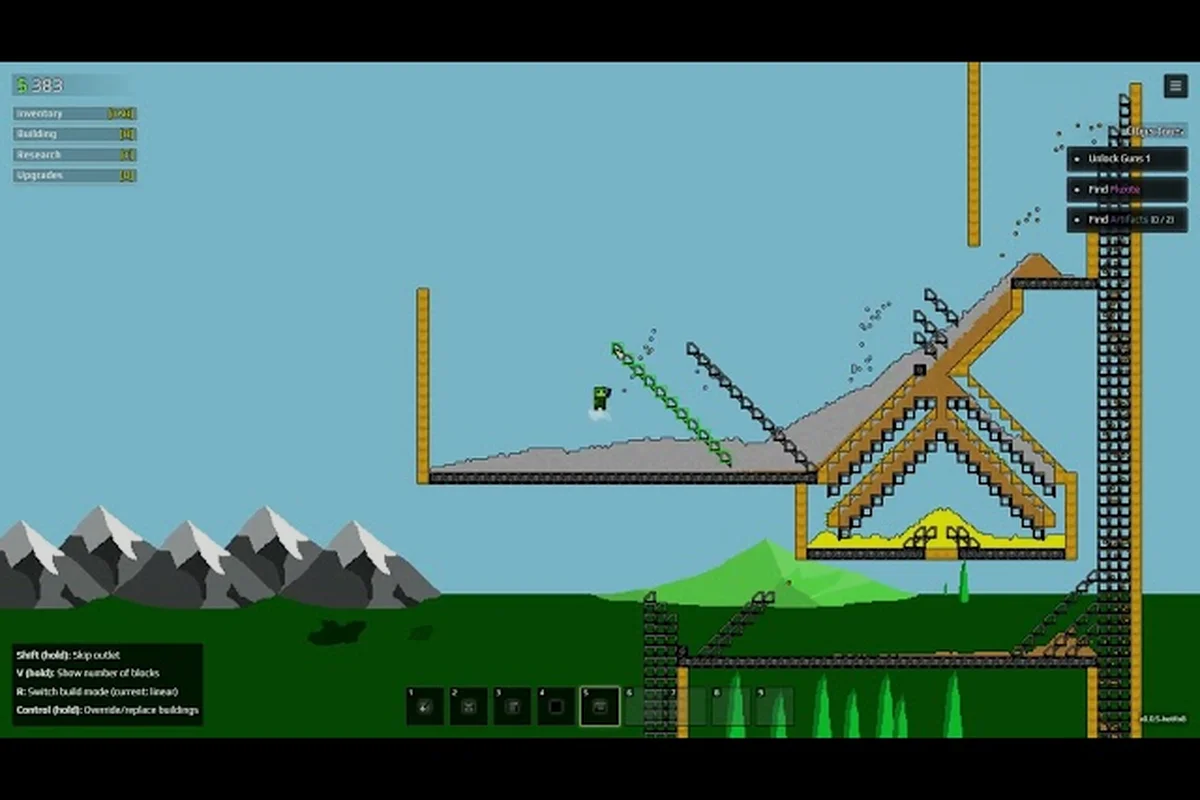
Sandustry sand physics sits at the heart of everything you build, because every grain in the world is simulated as an individual pixel rather than a static block. Understanding how sand falls, absorbs water, and interacts with heat means the difference between a factory that runs smoothly and one that clogs the moment you dig too deep. This guide breaks down the core simulation rules, the water cycle, and the practical tricks players use to control them.
The official Sandustry website describes the game as a factory builder where every pixel behaves independently, including sand, snow, seeds, spores, and ice chips. That single design choice creates emergent behavior you won't find in tile-based games, because materials don't just sit there. They slide, dissolve, melt, evaporate, and react to each other in ways that reward careful planning and punish careless excavation.
The Core of Sandustry Sand Physics: Falling and Settling
Sand behaves like a fluid that never stops moving, which is the first thing new players notice when they dig a tunnel and watch the ceiling pour down behind them. Each sand pixel checks the space below it every tick, and if that space is empty, it falls. If the space below is occupied but the diagonal spaces are open, the grain slides diagonally, which is why sand forms those characteristic sloped piles rather than perfect columns.
This behavior is governed by what the community calls the pixel simulation engine, and it applies equally to snow, seeds, and ice chips. The key difference is that sand is heavy and dense, so it settles quickly and compresses into stable formations. Snow, by contrast, falls slower and can be pushed around by water currents, which makes it useful for temporary barriers but terrible for structural work.
| Material | Fall Speed | Diagonal Slide | Water Interaction | Best Use |
|---|---|---|---|---|
| Sand | Fast | Yes | Absorbs water | Filtration, barriers |
| Snow | Slow | Yes | Melts into water | Temporary walls |
| Ice Chips | Medium | No | Melts into water | Cooling, transport |
| Seeds | Slow | Yes | Absorbs water, grows | Farming, decoration |
| Spores | Very Slow | Yes | Spreads on contact | Hazards, defense |
The falling behavior creates a self-leveling effect that experienced builders exploit. If you dump a load of sand into a pit, it spreads out evenly across the bottom instead of piling in one spot, which means you can use it to create flat foundations without manual smoothing. The trade-off is that any unsupported sand will eventually collapse, so you need to plan your excavation routes carefully or accept that your tunnels will fill back in.
How Sand Settles and Compacts
When sand falls onto a surface, it doesn't just stop. The pixels continue to shift and slide until they find a stable configuration, which typically takes a few seconds of simulation time. This settling behavior is why sand piles look organic and natural rather than blocky, and it's also why you can't build precise structures out of raw sand without containment.
The settling rate depends on the material density and the surface beneath it. Sand on sand compacts quickly, while sand on ice chips takes longer because the ice provides a slick surface that lets grains slide further. Players report that a 10-block deep sand column takes roughly 15 seconds to fully settle after being dumped, based on community testing of the current build.
Sand Water Absorption: How Moisture Moves Through Grains
The most important interaction in Sandustry sand physics is how sand absorbs surrounding water, because it directly affects your ability to manage liquids in the early game. When a sand pixel touches a water pixel, it begins absorbing moisture at a rate determined by the water pressure and the sand's saturation level. Dry sand pulls water aggressively, which is why a thin layer of sand can drain an entire reservoir if you're not careful.
The absorption mechanic works through a diffusion system rather than simple contact. Water spreads through sand horizontally and vertically, saturating grains one by one until the entire mass becomes wet. Wet sand behaves differently from dry sand: it's heavier, falls faster, and can't absorb any more water until it dries out. This creates a natural cycle where sand acts as both a sponge and a barrier, depending on its moisture state.
| Sand State | Water Capacity | Fall Speed | Uses |
|---|---|---|---|
| Dry | 100% | Normal | Filtration, absorption |
| Damp | 50% | Slightly faster | Partial barrier |
| Saturated | 0% | Fastest | Weight, sealing |
| Wet + Frozen | 0% | Very slow | Structural, temporary |
The saturation threshold matters because saturated sand stops absorbing entirely, which means you can use it to seal off water sources. Players often build sand dams by dumping dry sand into a stream, letting it absorb until saturated, then mining it out to create a permanent barrier. The trick is timing: if you mine too early, the sand is still dry and will absorb the water again; if you wait too long, the saturated sand becomes heavy and difficult to remove.
Practical Absorption Strategies
For players working on collecting resources, sand absorption is a double-edged sword. On one hand, you can use sand to clean up accidental spills and redirect water flows. On the other hand, a single misjudged dump can drain a water source you spent minutes building. The community recommends keeping a dry sand reserve in a sealed container specifically for emergency absorption, because wet sand is nearly useless for filtration.
The absorption rate scales with surface area, so a thin layer of sand spread across a wide area absorbs faster than a thick column. This is because more pixels are in direct contact with water, which accelerates the diffusion process. If you need to dry out a flooded area quickly, spread sand in a single layer rather than dumping it in a pile, then mine the wet sand and process it to recover the water.
How Ice Melts and the Sandustry Water Cycle
Ice melting is the starting point of the Sandustry water cycle, a closed loop that moves water from solid to liquid to gas and back again. Ice chips melt when they come into contact with warm materials or when the ambient temperature rises above freezing, which is why you'll see ice melt faster near machinery and slower in shaded areas. The melt rate depends on the temperature difference and the thermal conductivity of the surrounding material.
The official Sandustry Steam page confirms that ice melts to water, water boils to steam, and steam rises and condenses into rain. This full cycle is simulated in real time, which means your factory's heat output can actually create localized weather patterns. Players report that large-scale smelting operations can generate enough steam to trigger rain clouds directly above their base, which is both a blessing for water collection and a curse for visibility.
| Phase Change | Trigger | Result | Speed |
|---|---|---|---|
| Ice to Water | Temperature above freezing | Liquid water | Slow |
| Water to Steam | Temperature above boiling | Rising steam | Medium |
| Steam to Rain | Cooling at height | Falling water | Fast |
| Water to Ice | Temperature below freezing | Solid ice | Slow |
The melting behavior is directional, meaning ice melts from the outside in rather than all at once. This creates a visual effect where ice blocks slowly shrink and drip water, which can be used to create passive water sources. Players who understand this mechanic can build ice-based water generators that produce a steady trickle of water without any pumps or machinery, simply by keeping ice in a warm environment.
The Full Water Cycle in Practice
Understanding the Sandustry water cycle requires thinking about the three states of matter as a single system rather than separate materials. Water evaporates from open reservoirs, steam rises until it hits a cooler layer, and then condenses into rain that falls back down. This cycle is always running in the background, which means your water management decisions have long-term consequences.
For players interested in the steam guide, the condensation point is the critical variable. Steam rises until it reaches a temperature threshold, then condenses into water droplets that fall as rain. If you build a tall chimney, the steam will condense at the top and rain back down into your base, which can be either helpful or disastrous depending on your setup. The community recommends building condensation towers that collect the rain in a dedicated reservoir, turning waste steam into a renewable water source.
How Steam Works and Heat-Driven Physics
Steam is the most dynamic material in Sandustry because it's constantly moving and changing state. When water reaches boiling temperature, it converts to steam and rises rapidly, pushing through any gaps in your structures. The steam behavior is governed by pressure and temperature, so steam will always seek the highest point available, even if that means escaping through cracks in your roof.
The steam-to-rain conversion happens when steam reaches a cooler altitude and loses enough thermal energy. This is why steam rises in visible columns and then disappears at a certain height, because that's where condensation occurs. The height varies based on ambient temperature, which means steam columns are taller in cold biomes and shorter in warm ones. Players report that the condensation height can change by up to 30% depending on the environment, based on community observations.
| Heat Source | Temperature | Steam Production | Best Use |
|---|---|---|---|
| Furnace | High | Fast | Smelting, power |
| Boiler | Very High | Very Fast | Steam engines |
| Lava | Extreme | Instant | Emergency, danger |
| Machinery | Low | Slow | Passive, incidental |
The steam pressure mechanic creates interesting building challenges because steam can damage structures if it's contained too tightly. The simulation treats steam as a gas that expands to fill available space, and when that space is limited, the pressure builds until something breaks. This is why experienced players always include pressure relief valves in their steam systems, usually in the form of a small vent that allows excess steam to escape harmlessly.
Managing Heat and Steam Systems
For players working with boiling water mechanics, the key insight is that steam production scales with surface area, not just temperature. A wide, shallow boiler produces more steam than a narrow, deep one because more water is in direct contact with the heat source. This means boiler design is about maximizing contact area while maintaining structural integrity, which is a classic Sandustry engineering puzzle.
The steam condensation process can be controlled by adjusting the height of your steam chambers. If you want to collect water, build your condensation point low; if you want to vent steam away, build it high. The community has developed several steam management patterns that balance production and collection, and most of them involve careful height calculations based on the ambient temperature of your build location.
Sandustry Pixel Physics: The Simulation Engine Explained
The pixel simulation engine is what makes Sandustry unique among factory games, because every material is broken down into individual pixels that each follow their own rules. This is different from traditional tile-based games where blocks are uniform and static. In Sandustry, a pile of sand is literally thousands of individual grains, each one checking its surroundings and deciding whether to fall, slide, or absorb water.
The simulation runs at a fixed tick rate, and each tick updates every pixel in the world. This is computationally expensive, which is why the game uses clever optimizations to keep performance reasonable. The official simulation rewrite video shows the before-and-after comparison, demonstrating how the developers improved water flow, ice melting, and steam behavior in a major update.
| Simulation Feature | Before Rewrite | After Rewrite |
|---|---|---|
| Water Flow | Blocky, slow | Smooth, realistic |
| Ice Melting | Instant | Gradual, directional |
| Steam Rising | Unrealistic | Pressure-based |
| Sand Settling | Simple fall | Complex slide |
| Overall Performance | 30 FPS | 60 FPS |
The pixel-level interaction means that materials don't just coexist; they actively react to each other. Sand absorbs water, water boils into steam, steam condenses into rain, and rain falls on sand to start the cycle again. This creates emergent behavior that players can exploit, but it also means that unexpected interactions can cause cascading failures if you're not careful.
Performance and Optimization
The simulation cost scales with the number of active pixels, which is why the game recommends keeping your builds compact rather than sprawling. A single large sand pile can lag the game because every grain needs to be updated each tick. The community recommends using containment structures to minimize active sand pixels, such as storing sand in sealed bins rather than leaving it in open piles.
The simulation rewrite video demonstrates how the developers optimized the engine to handle more active pixels without sacrificing performance. The key improvement was implementing a priority system that updates moving pixels more frequently than static ones, which means settled sand costs almost nothing to simulate while falling sand gets full attention. This optimization allows players to build larger sand-based structures without worrying about frame rate drops.
Advanced Sand Physics Techniques
Once you understand the basics of Sandustry sand physics, you can start using advanced techniques that exploit the simulation's quirks. One of the most useful is sand-based water filtration, which uses the absorption mechanic to purify contaminated water. By passing water through a thick sand layer, you can remove impurities and collect clean water on the other side, which is essential for certain production chains.
Another advanced technique is sand column stabilization, which uses the settling behavior to create temporary structures. If you dump sand into a pit and wait for it to settle, you can mine out a stable tunnel that won't collapse because the surrounding sand has compacted into a solid mass. This is faster than building traditional supports, but it requires patience and careful timing.
| Technique | Difficulty | Time Investment | Payoff |
|---|---|---|---|
| Sand Filtration | Easy | Low | Clean water |
| Sand Dams | Medium | Medium | Water control |
| Steam Condensation | Medium | High | Renewable water |
| Pressure Venting | Hard | High | Safe steam use |
| Sand Stabilization | Hard | High | Fast tunneling |
The sand water absorption mechanic also enables a clever trick for creating artificial lakes. By building a sand barrier, filling the area behind it with water, and then mining out the sand, you can create a reservoir that holds water indefinitely. The key is to let the sand saturate completely before mining, because partially saturated sand will absorb the water and drain your lake.
Advanced Steam Control
For players who want to master the steam mechanics, the advanced technique is steam recycling, which captures rising steam and condenses it back into water before it escapes. This requires building a sealed chamber with a condensation point at the top, then collecting the water that drips down. The efficiency depends on the height and insulation of your chamber, with taller chambers generally performing better.
The temperature mechanics that drive steam production are covered in more detail in the temperature mechanics guide, but the key principle is that heat flows from hot to cold. This means your steam chambers need to be insulated from cold environments, or the steam will condense too quickly and reduce your production efficiency. The community recommends using double-walled construction with an air gap to maintain consistent temperatures.
Frequently Asked Questions
How does sand absorb water in Sandustry?
Sand absorbs water through a diffusion mechanic where moisture spreads through adjacent sand pixels. Dry sand pulls water aggressively until saturated, at which point it stops absorbing entirely. The absorption rate depends on surface area, so thin sand layers absorb faster than thick piles.
What happens when ice melts in Sandustry?
Ice melts into water when the surrounding temperature rises above freezing, and the melting happens gradually from the outside in. The melt rate depends on temperature difference and thermal conductivity of nearby materials. Melted ice contributes to the water cycle by feeding reservoirs and potentially boiling into steam.
How does the steam cycle work in Sandustry?
Water boils into steam when heated above boiling temperature, and the steam rises until it reaches a cooler altitude where it condenses into rain. The condensation height varies with ambient temperature, and the rain falls back down to complete the cycle. This creates a closed loop that players can exploit for renewable water.
Can sand be used to stop water flow?
Yes, saturated sand acts as a water barrier because it stops absorbing once full. Players build sand dams by dumping dry sand into water, waiting for saturation, then mining it out to create permanent barriers. The timing is critical because partially saturated sand will continue absorbing.
What is the pixel simulation in Sandustry?
The pixel simulation treats every material as individual grains, not blocks. Sand tumbles downhill, water seeps and evaporates, steam rises and condenses—each pixel follows its own rules. These micro-interactions create emergent behavior, like sand absorbing water to form temporary barriers or filtration layers, making Sandustry’s physics feel alive and endlessly exploitable.