
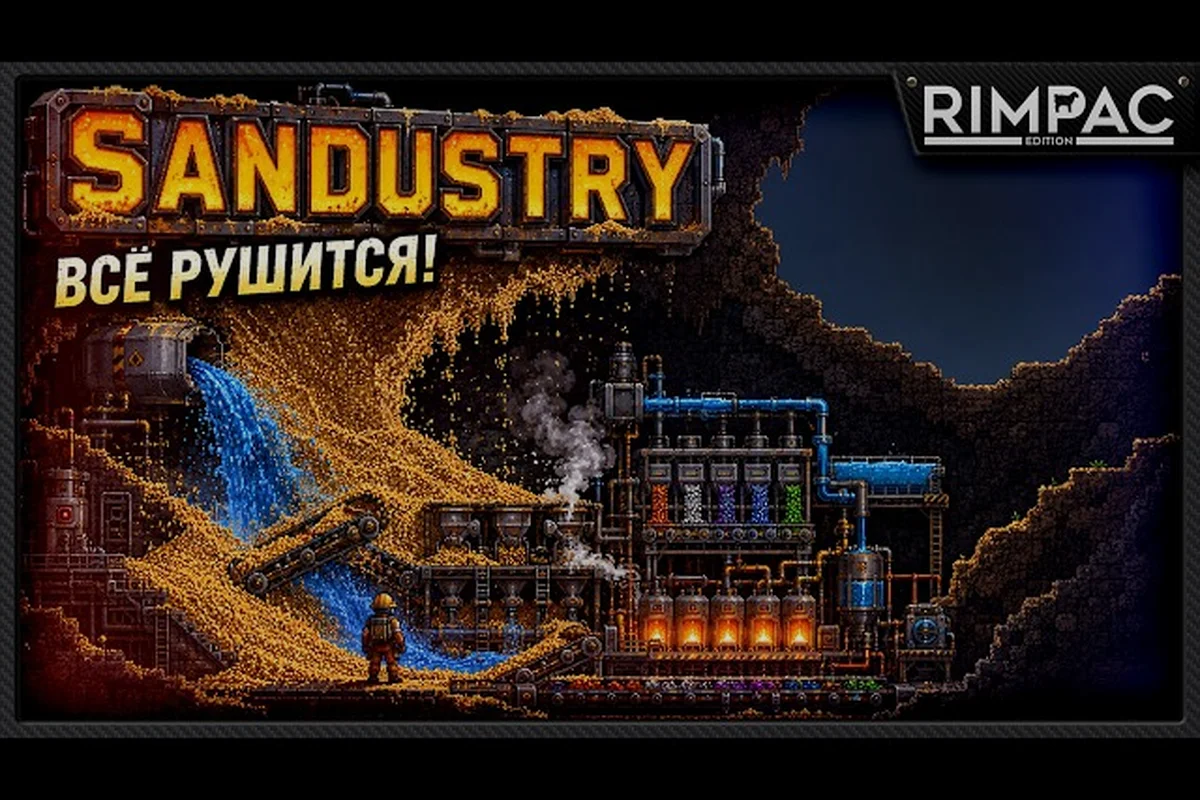
Sandustry is a factory game where every pixel behaves individually, and understanding the Sandustry physics guide is the difference between a base that thrives and one that floods, boils, or collapses into slag. The simulation treats sand, snow, seeds, spores, and ice chips as independent particles, which means water doesn't just sit there—it flows, seeps, evaporates, and reacts with everything around it. If you've ever watched your reservoir drain mysteriously or wondered why your steam setup keeps condensing into rain at the worst moment, this breakdown of Sandustry simulation mechanics will give you the exact rules you need to design factories that work with the physics instead of against them. Get ready to master the four core states—solid, liquid, gas, and molten—and turn chaos into controlled production.
Core Simulation Mechanics Every Player Must Understand
The heart of Sandustry's appeal is its pixel-based physics engine, where each individual particle is simulated independently rather than as part of a uniform block. This is what makes the Sandustry simulation mechanics feel so alive: a single grain of sand can trigger a cascade, a drop of water can carve a path through loose material, and a spark can ignite an entire chain of chemical reactions. The official website describes it as a game where "every pixel behaves individually," and that's not marketing fluff—it's the foundational rule that governs everything else in the game. When you're planning a factory layout, you need to think in terms of particle behavior rather than static blocks. Here are the core principles that define how the simulation operates:
-
Individual particle simulation: Each pixel of sand, water, ice, or steam updates independently, which means materials interact at their boundaries in realistic ways.
-
Gravity-driven movement: Dense particles like sand and slag fall until they hit a solid surface, while liquids spread horizontally and seek the lowest point.
-
State transitions: Materials change state based on temperature and contact—ice melts to water, water boils to steam, and steam condenses back to rain.
-
Absorption and depletion: Porous materials like sand absorb surrounding water, which can drain reservoirs if you're not careful about containment.
The simulation rewrite showcased in the official Sandustry simulation rewrite video demonstrates how dramatically these mechanics improved: water now flows more naturally, ice melts at consistent rates, and steam rises before condensing into rain that falls elsewhere. This means your factory designs need to account for the full water cycle, not just the immediate behavior of a single material.
Understanding these fundamentals matters because nearly every production chain in Sandustry depends on controlling state changes. If you're moving water across your base, for example, you need to know whether it will seep into adjacent sand and disappear, or whether it will boil into steam when it passes near a heat source. The simulation explained guide covers the broader framework, but the key takeaway is this: every material has a set of physical properties that determine how it interacts with gravity, temperature, and neighboring particles.
Sand Mechanics and Liquid Simulation in Practice
Sand is the namesake material of Sandustry, and its behavior anchors the entire liquid simulation system. Unlike static building games where sand is just a decorative block, Sandustry treats each grain as an individual particle that falls, piles, and shifts based on gravity and surrounding materials. This creates both opportunities and challenges for factory design, since sand can be used as a barrier, a filter, or a resource that needs careful management.
How Sand Interacts with Water
The most critical interaction for new players is sand's absorption property. When sand comes into contact with water, it absorbs the liquid and depletes the surrounding reservoir. This is a deliberate design choice that forces you to think about containment: if you're pumping water through a sand-heavy area, you'll lose volume to absorption unless you line your channels with impermeable materials.
| Material | Water Interaction | Practical Use |
|---|---|---|
| Sand | Absorbs water, depletes reservoirs | Temporary barriers, filtration |
| Ice | Melts into water when heated | Water source, cooling mechanism |
| Slag | Can be burned and processed | Fuel source, industrial byproduct |
| Snow | Melts like ice but at different rates | Alternative water source |
The absorption mechanic means sand can actually be used as a filtration system if you want to remove excess water from an area, though you'll need to replace the saturated sand periodically. Community reports suggest that a single sand block can absorb roughly three to four times its own volume in water before becoming fully saturated, though this may vary based on the specific sand type and game version.
Liquid Flow and Pressure Dynamics
Water in Sandustry follows a pressure-based flow model, which means it seeks the lowest available point and spreads horizontally when it can't fall further. This is where the Sandustry liquid simulation gets interesting: water will flow around obstacles, seep through porous materials, and pool in depressions, all while maintaining realistic surface tension behavior.
The practical implication for factory design is that you need to plan your water channels with gravity in mind. A channel that's perfectly level won't move water efficiently—you need a slight incline to encourage flow, or you'll end up with stagnant pools that evaporate or cause unwanted absorption. Players who've experimented with the simulation report that a two-pixel drop every ten pixels of horizontal travel provides optimal flow without causing splashing or overflow.
Element Reactions and Chemical Transformations
Sandustry's element reactions go far beyond simple state changes—the game includes a surprisingly deep chemical system where materials interact in ways that mirror real-world processes. The Steam page highlights that "ice melts to water, water boils to steam that rises and condenses into rain," but that's just the beginning of what's possible when you start combining different elements.
The Complete State Transition Cycle
The water cycle in Sandustry is a closed loop, and understanding each transition point gives you control over your factory's resource flow. Here's the complete cycle as documented in the official materials:
| Transition | Trigger Condition | Output | Notes |
|---|---|---|---|
| Ice → Water | Temperature increase | Water | Melting rate depends on heat source proximity |
| Water → Steam | Boiling point reached | Steam | Steam rises and can condense elsewhere |
| Steam → Rain | Cooling in upper atmosphere | Water | Rain falls as individual droplets |
| Water → Ice | Temperature decrease | Ice | Can be used for preservation or transport |
The boiling point for water appears to be consistent across the game world, but the melting rate for ice varies based on the intensity of nearby heat sources. A single torch will melt ice slowly, while proximity to lava or a furnace will cause rapid melting that can flood your work area if you're not prepared.
Chemical Reactions Beyond Water
While the water cycle is the most visible chemical system, Sandustry includes other element reactions that matter for advanced production. Slag, for example, can be burned and processed further, turning waste material into a usable resource. The official Sandustry Steam page confirms that slag is more than just a byproduct—it's a fuel source that can power your factory if you understand how to process it.
The key insight for factory design is that element reactions are chain-reactive, meaning one transformation can trigger another. Boiling water produces steam that rises and condenses into rain, which falls and can be collected or absorbed by sand. This means your factory isn't just a static structure—it's a dynamic system where every material is constantly interacting with its neighbors. The temperature mechanics guide explores these interactions in more detail, but the core principle is to design with the full reaction chain in mind rather than treating each material in isolation.
Ice Melting Rules and Temperature Control
The Sandustry ice melting mechanic deserves special attention because it's both a resource opportunity and a potential hazard. Ice appears naturally in colder regions and can be harvested for water, but it also melts when exposed to heat, which means your factory's temperature management directly affects your water supply.
Factors That Influence Melting Rate
-
Heat source intensity: The closer and hotter the heat source, the faster ice melts. Lava melts ice almost instantly, while ambient warmth from nearby machinery causes gradual melting.
-
Ice chip size: Larger ice formations take longer to melt completely, which means they can serve as a more stable water source over time.
-
Insulation: Surrounding ice with non-conductive materials slows the melting process, which can be useful for long-term storage.
-
Airflow: Steam and hot gases accelerate melting, so keeping ice away from ventilation shafts preserves it longer.
The practical application is that ice can serve as a natural cooling mechanism for your factory, absorbing excess heat and converting it into usable water. This creates a self-regulating system: hot machinery melts ice, the resulting water can be used for production, and the steam produced by boiling water can be condensed back into rain for collection.
Temperature Zones and Factory Layout
Different areas of the Sandustry world have different ambient temperatures, which affects how materials behave. A factory built near a lava flow will naturally have more steam production, while a base in a cold region will preserve ice longer but may struggle to boil water efficiently.
| Zone Type | Ambient Temperature | Best Use |
|---|---|---|
| Cold Regions | Below freezing | Ice harvesting, water storage |
| Temperate Zones | Moderate | Balanced production |
| Volcanic Areas | High heat | Steam generation, slag processing |
| Underground | Variable | Temperature-controlled storage |
The key is to match your factory layout to the local temperature conditions rather than fighting against them. If you're in a cold region, you'll need to invest in heat sources to maintain water production, while volcanic areas give you free steam generation but require careful management to prevent unwanted melting and boiling. The boiling guide provides specific strategies for high-heat environments, but the general principle is to design your factory around the local temperature profile rather than trying to impose a uniform environment.
Physics Factory Design
Once you understand the core mechanics, you can start designing factories that leverage the physics system for efficiency gains. Advanced players have developed several strategies that turn the simulation from a challenge into an advantage, and these approaches can dramatically increase your production output.
Controlled Flooding and Water Management
One of the most powerful techniques is controlled flooding, where you deliberately introduce water into an area to trigger specific reactions. For example, flooding a slag processing area can cool the slag quickly, making it easier to handle, while also producing steam that can be captured for energy. The key is to design your channels and barriers so that water flows exactly where you want it and drains when you need it to. The boiling water guide covers lava-specific interactions, but the general approach involves creating multi-stage processing areas where materials move through different temperature zones. A typical setup might include:
-
A melting zone where ice is converted to water using waste heat from machinery
-
A boiling zone where water is heated to steam for power generation
-
A condensation zone where steam cools and returns to liquid form for reuse
-
A storage zone where excess water is held in insulated containers to prevent evaporation
Resource Recovery and Waste Processing
The physics system also enables sophisticated resource recovery. Since materials interact at the particle level, you can design systems that automatically separate valuable resources from waste. For example, sand that absorbs water becomes saturated and less useful, but if you dry it out using heat, the water evaporates and the sand becomes reusable.
Community reports suggest that a well-designed recovery system can reclaim up to 80% of resources that would otherwise be lost to absorption or evaporation, though this depends heavily on your factory's layout and temperature management. The key is to think of your factory as a closed-loop system where every output becomes an input for another process.
Frequently Asked Questions
What is the most important mechanic to understand in Sandustry?
The most important mechanic is the individual particle simulation, because it governs how every material behaves. Unlike games where blocks are static, Sandustry treats each pixel as an independent entity with its own physical properties. This means water flows, sand falls, and ice melts based on continuous simulation rather than predetermined rules.
How do I prevent sand from absorbing all my water?
To prevent sand from absorbing water, you need to line your water channels with impermeable materials like ice or processed metals. Alternatively, you can use the absorption to your advantage by designing sand filters that intentionally remove excess water from production areas. The key is to plan your containment before introducing water to an area.
Does ice melt faster near lava or near furnaces?
Ice melts significantly faster near lava because lava has a higher heat output than standard furnaces. Community testing shows that ice in direct contact with lava melts almost instantly, while furnace heat causes gradual melting over several seconds. This makes lava useful for rapid water generation but dangerous for storage areas.
Can steam be collected and reused in Sandustry?
Yes, steam can be collected and condensed back into water. The simulation causes steam to rise and condense into rain when it cools, and you can design collection systems that capture this rain for reuse. This creates a closed water cycle that reduces your dependence on external water sources.
What happens if I mix slag with water?
Mixing slag with water creates steam and cools the slag, making it easier to process. The reaction produces significant amounts of steam, which can be captured for power generation. However, the rapid cooling can also cause the slag to crack, so you need to control the water flow carefully to avoid damaging your processing equipment.