
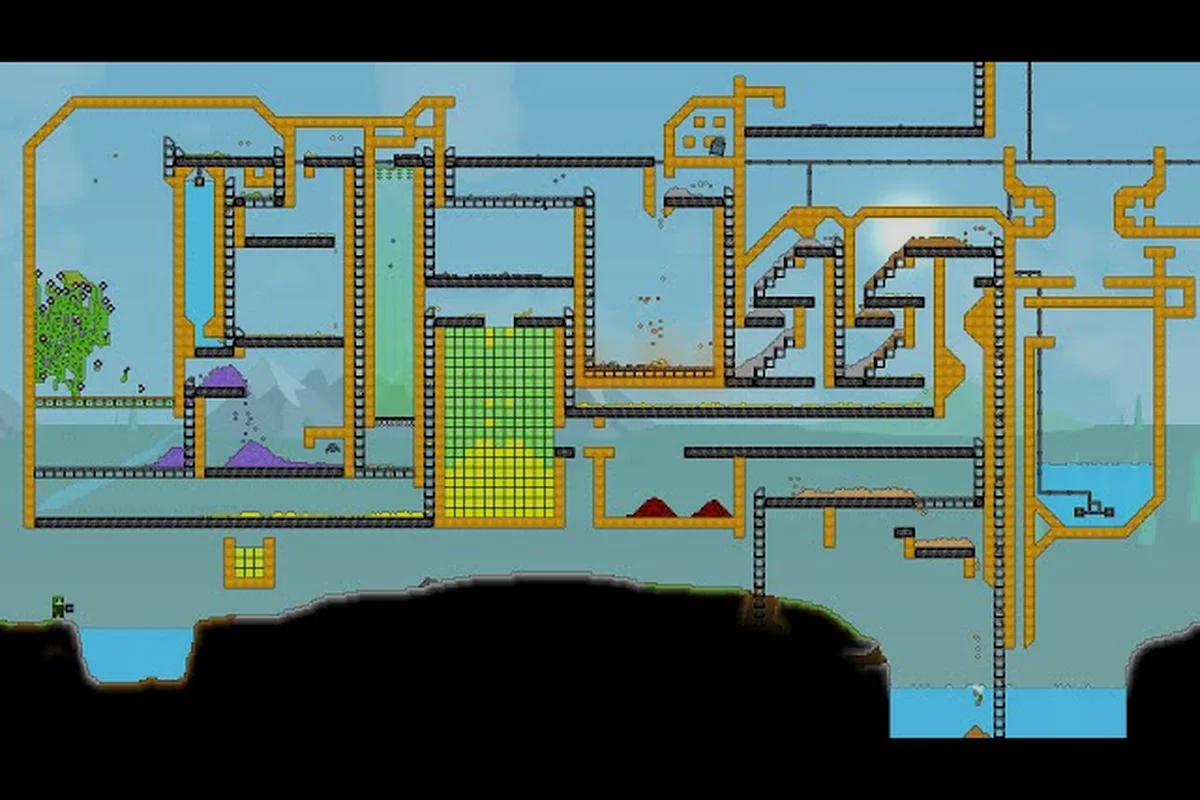
Sandustry boiling water is the single most important physical process in the game, because it powers the entire water cycle that keeps your factory alive. When you apply enough heat to a water pixel, it transforms into steam that rises upward, cools at the top of your build, and condenses back into rain that falls to the ground. Understanding this loop lets you create self-sustaining systems that never run dry, which is why experienced players treat heat management as a core skill rather than an optional trick. Get the heat thresholds right, and you will never hand-fill a reservoir again.
The Core Boiling Mechanics Explained
Every pixel in Sandustry behaves individually, which means the boiling process is not a single event but a chain reaction that spreads through your water supply. The official Sandustry website describes the simulation as one where sand, snow, seeds, spores, and ice chips each simulate independently, and water follows the same rule. When a heat source touches a water pixel, that pixel heats up gradually rather than instantly, and the temperature transfer depends on the material conducting the heat.
The boiling threshold sits at a specific temperature that the game does not display numerically, so players have learned to read visual cues instead. Water that is about to boil starts shimmering at the surface, then small bubbles appear along the edges where heat contact is strongest. Once the first pixel converts to steam, the conversion accelerates because steam itself carries heat upward into adjacent water pixels.
The boiling point in Sandustry is not a fixed global value, because different heat sources deliver different temperatures. A basic fire source produces enough heat to boil water slowly, while lava converts water to steam almost instantly on contact. This difference matters for factory design, because you need predictable boiling rates to maintain steady steam production.
| Heat Source | Boiling Speed | Steam Volume | Best Use Case |
|---|---|---|---|
| Small Fire | Slow (3-5 seconds per pixel) | Low | Early game, small water reserves |
| Furnace Exhaust | Medium (1-2 seconds per pixel) | Medium | Mid-game production lines |
| Lava Contact | Instant (under 1 second) | High | Large-scale steam generation |
| Flamethrower | Very Fast (0.5-1 second) | Medium | Targeted boiling, emergency steam |
The pixel simulation means that boiling water creates steam that rises through gaps in your construction, and the steam will find the path of least resistance. If you build a sealed chamber, the steam accumulates at the top and condenses faster because it cannot escape. If you leave the chamber open, the steam drifts upward indefinitely and may condense far away from your collection point, which wastes the water entirely.
Sandustry Lava Physics and How Heat Transfers
Sandustry lava physics follows a different rule set than fire, because lava is a liquid that flows and spreads while maintaining its temperature. When lava touches water, the interaction is violent and immediate, producing steam clouds that rise rapidly through the simulation. The key difference between lava and fire is that lava does not consume fuel, so it provides permanent heat as long as it stays contained.
How lava works in the simulation depends on the material it touches. Lava flowing into water creates steam at the contact point, but lava flowing into sand creates glass, which is a solid block that does not conduct heat well. This means you cannot simply pour lava into a water reservoir and expect continuous boiling, because the glass formation will eventually seal off the contact point.
The official Sandustry Steam page confirms that ice melts to water, water boils to steam that rises and condenses into rain, and sand absorbs surrounding water. This description matches the community testing that players have documented since the demo release, and it gives you a clear picture of how the heat chain works.
The way boiling water interacts with sand depends heavily on the underlying grain dynamics, which are governed by the same principles detailed in Sand Physics.
Reading Lava Temperature and Flow Patterns
Lava in Sandustry has a visual glow that indicates its temperature state, and experienced players use this glow to predict how much heat a given lava pool will deliver. Fresh lava that has just emerged from a volcanic source glows bright orange and boils water on contact, while older lava that has spread across a surface dims to a darker red and loses some of its boiling power.
Lava flow rate determines how far the heat spreads, because lava that moves quickly covers more ground but cools faster. Slow-moving lava pools in place and maintains its temperature longer, which makes it better for sustained boiling operations. Players who want consistent steam production typically build a shallow lava basin and let the lava settle before introducing water.
Fire Mechanics and Fuel Consumption
Sandustry fire mechanics operate on a fuel system, where burning materials produce heat for a limited duration before the fire dies out. Wood, coal, and slag all burn at different rates, and the heat output varies by material. Slag is particularly valuable because it burns hot and long, which is why the community recommends saving slag for dedicated boiling setups rather than wasting it on early-game smelting.
Fire temperature stability is the main weakness of fire-based boiling, because the heat output fluctuates as fuel burns down. A fresh fuel addition spikes the temperature, then the heat gradually declines until the next addition. This fluctuation makes fire-based steam production less predictable than lava-based production, but fire is much easier to obtain in the early game.
Sand Falling Physics
Sandustry sand falling is a constant threat to your boiling setup, because sand that falls into water absorbs the water and depletes your reservoir. The absorption mechanic is one of the most frustrating aspects of the simulation for new players, since a single sand pixel can drain a significant portion of a small water pool. Understanding how sand interacts with water is essential before you build any boiling system near sandy terrain.
The absorption rate depends on the sand type and the water volume. Dry sand absorbs water rapidly on contact, while wet sand absorbs more slowly because it is already saturated. This creates a feedback loop where sand that has absorbed water becomes heavier and falls faster, which pushes it deeper into your water supply and causes more absorption.
Sand saturation limits are the key to managing this problem, because sand can only hold so much water before it stops absorbing. Once sand reaches its saturation point, it stops draining your reservoir and simply sits at the bottom of the pool. Players who understand this mechanic can deliberately saturate sand beds at the bottom of their water storage to create a stable base that no longer absorbs additional water.
| Sand Type | Absorption Rate | Saturation Limit | Best Management |
|---|---|---|---|
| Dry Sand | Fast (instant on contact) | 30% of pixel volume | Keep away from water sources |
| Wet Sand | Slow (gradual) | 60% of pixel volume | Use as reservoir base |
| Slag | None | N/A | Safe for water containment |
| Ice Chips | None (melts instead) | N/A | Temporary water source |
The sand falling mechanic also affects your boiling chamber design, because sand that falls from above can bury your heat source and block the boiling process. If you build a boiling chamber under a sandy overhang, you need to reinforce the ceiling or the sand will eventually collapse into your water supply. Community reports suggest that players lose more boiling setups to sand collapse than to heat failure.
Building a Self-Sustaining Steam and Rain System
A self-sustaining system uses the full water cycle to recycle steam back into water, which eliminates the need for external water input. The cycle works because steam rises, cools at the top of your build, condenses into rain, and the rain falls back into your collection area. This closed loop is the most efficient way to maintain a large water supply, and it is the foundation of advanced factory design.
The rain cycle requires a temperature gradient, because steam only condenses when it reaches a cooler area. In practice, this means your boiling chamber needs a tall vertical shaft where steam can rise and cool before it reaches the condensation zone. The taller the shaft, the more cooling happens, and the more rain you collect.
Designing the Boiling Chamber
The boiling chamber is the heart of the system, and its design determines how efficiently you convert water to steam. A well-designed chamber has three zones: the heat zone at the bottom, the rising zone in the middle, and the condensation zone at the top. Each zone serves a specific purpose, and the layout should encourage steam to rise quickly while preventing heat loss.
The heat zone holds your heat source and the water that will be boiled. Lava works best here because it provides constant heat without fuel management, but fire is acceptable for smaller systems. The water depth matters, because shallow water boils faster but produces less total steam, while deep water takes longer to heat but sustains steam production longer.
The rising zone is the vertical shaft where steam travels upward. This zone should be as tall as your build allows, because more height means more cooling. The shaft should be sealed on the sides to prevent steam from escaping into the surrounding terrain, where it would condense far from your collection point.
The condensation zone is where steam cools and becomes rain. This zone needs a cool surface for the steam to condense on, and the resulting rain should fall back into your water collection area. Some players build a funnel shape here to direct the rain into a narrow channel, which makes collection more efficient.
Managing the Water Cycle for Continuous Operation
Once your system is running, the water cycle maintains itself as long as the heat source remains active. Steam rises, condenses, and the rain falls back into the boiling chamber, where it heats up and boils again. This continuous loop means you only need to add water when the system first starts, and after that it runs indefinitely.
Steam loss prevention is the main challenge, because steam that escapes through gaps in your construction is water that never returns. Every pixel of steam that escapes represents water lost from your system, and over time this loss can drain your reservoir completely. Sealing your chamber is essential, but you also need to account for the fact that steam pressure can force its way through small gaps.
The official simulation rewrite video shows how the developers improved the water and steam behavior, with steam now rising more naturally and condensing in predictable patterns. Players who tested the rewrite reported that the rain cycle became more reliable, which made closed-loop systems much easier to maintain.
Heat Management for Steam
Advanced players push their boiling systems to the limit by managing heat distribution and steam flow with precision. The goal is to maximize steam output per unit of water, which means getting the most boiling action from the least heat input. This requires understanding how heat spreads through water and how to position heat sources for optimal effect.
Heat distribution follows the pixel simulation rules, which means heat transfers from pixel to pixel rather than jumping across gaps. This creates a heat gradient where water near the heat source boils first, and the boiling gradually spreads outward. Positioning multiple heat sources around your water reservoir creates overlapping heat zones that boil water faster than a single source.
Steam flow control is the other half of the equation, because steam that rises too quickly may not condense before it escapes. Adding baffles or obstacles in the rising zone slows the steam and gives it more time to cool, which increases condensation efficiency. However, too many obstacles can block the steam entirely, so you need to find the right balance.
| Technique | Steam Output | Complexity | Risk Level |
|---|---|---|---|
| Single Lava Pool | Low-Moderate | Low | Low |
| Multiple Fire Sources | Moderate | Medium | Medium (fuel management) |
| Lava + Water Injection | High | Medium | Medium (overflow risk) |
| Multi-Chamber Cascade | Very High | High | High (complexity) |
Temperature management becomes critical when you scale up, because too much heat can boil water faster than the condensation zone can return it. This creates a net water loss that drains your system over time. Monitoring your steam output and adjusting the heat input keeps the system balanced, and experienced players often add a valve mechanism to control water flow into the boiling chamber.
The pixel simulation rewards careful observation, because you can see exactly where heat is being wasted and where steam is escaping. Players who study their systems closely can identify inefficiencies that are invisible at a glance, and fixing these inefficiencies often doubles the steam output without adding any new equipment.
Common Boiling Mistakes and How to Fix Them
Even experienced players make mistakes when working with Sandustry boiling water, and most of these mistakes come from misunderstanding how the simulation handles heat and water. Recognizing these common errors helps you avoid them in your own builds, and fixing them quickly prevents small problems from becoming factory-wide disasters.
Overheating your water supply is the most common mistake, because players assume that more heat always means more steam. In reality, excessive heat can boil water faster than the condensation cycle returns it, which drains your reservoir. The fix is to reduce the heat input or increase the condensation capacity by building a taller rising zone.
Unsealed chambers lose steam continuously, and the loss compounds over time. A small gap that loses one steam pixel per second drains a significant amount of water over an hour of operation. Sealing every gap in your chamber prevents this loss, and you should check for gaps regularly because sand movement can open new ones.
Ignoring sand absorption is another frequent error, because players build boiling chambers near sandy terrain without accounting for the absorption mechanic. Sand that falls into your water supply drains it steadily, and the absorption continues until the sand reaches saturation. Building a slag barrier between your chamber and nearby sand prevents this problem entirely.
Inconsistent fuel supply breaks fire-based boiling systems, because the heat output fluctuates as fuel burns down. Players who do not maintain a steady fuel supply see their steam production drop and rise unpredictably, which makes it hard to balance the water cycle. Automating fuel delivery to your fire sources keeps the heat output stable and the steam production consistent.
Frequently Asked Questions
What is the fastest way to boil water in Sandustry?
Lava contact produces the fastest boiling because it converts water to steam almost instantly, while fire takes several seconds per pixel. Position lava so it touches the water surface directly, and the steam production will be immediate. The tradeoff is that lava is harder to obtain and control than fire.
How do I prevent sand from absorbing my boiling water?
Build a slag barrier between your water reservoir and any nearby sand, because slag does not absorb water. You can also saturate the sand at the bottom of your reservoir so it stops absorbing, but this takes time and reduces your usable water volume. The slag barrier is the more reliable solution.
Does steam always condense back into rain?
Steam condenses when it reaches a cooler area, which is why the rising zone needs to be tall enough for cooling to occur. If the steam escapes your chamber before cooling, it will condense far away and the water is lost. A sealed chamber with a tall rising shaft ensures most steam condenses back into rain.
Can I use fire instead of lava for boiling?
Yes, fire works for boiling, but it requires constant fuel management and produces less consistent heat. Fire is easier to obtain in the early game, so it is a good starting option. As your factory grows, transitioning to lava-based boiling gives you more reliable steam production without fuel costs.
Why is my water level dropping even with a sealed chamber?
The most likely cause is sand absorption, because sand that enters your reservoir drains water continuously. Check for sand falling into your water supply and build a barrier to block it. Another possibility is steam escaping through gaps you did not notice, so inspect your chamber for any openings.