
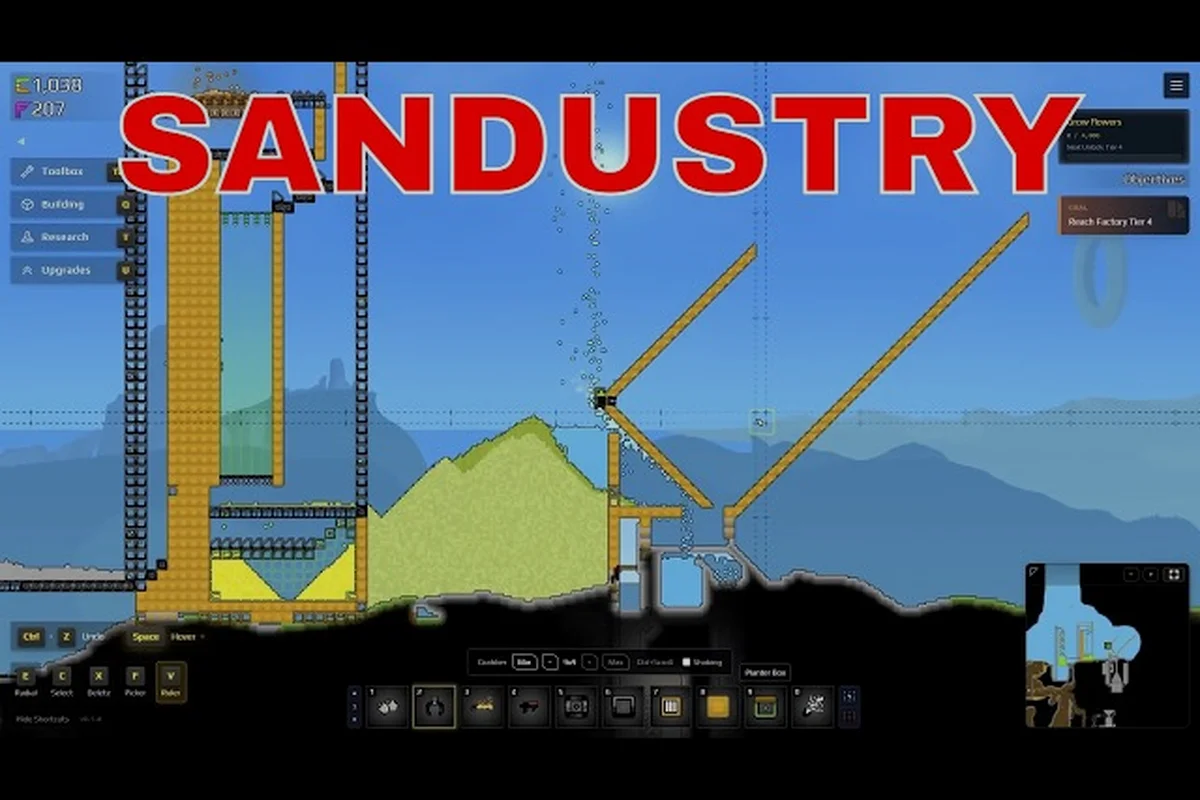
Most factory games treat their world as a static grid, but Sandustry breaks that assumption completely. Every pixel behaves individually — sand grains tumble, water seeks its level, steam rises and condenses back into rain — which means your production lines must respect physics rather than fight it. This Sandustry deep dive guide exists for players who have mastered the basics and now want to understand the simulation layer beneath the factory floor, because that understanding separates a functional base from an elegant one.
The official Sandustry website describes the core promise plainly: sand, snow, seeds, spores, and ice chips each simulate independently. That single sentence hides enormous complexity, and once you internalize it, you will never build a conveyor line the same way again. If you are still finding your footing with the fundamentals, our Sandustry complete beginners guide covers the early hours, while this deep dive focuses on the systems that reward careful observation.
The Pixel Simulation Engine and Why It Changes Everything
The heart of Sandustry is its pixel simulation engine, which treats every material as a collection of individual cells rather than a uniform block. This is not a cosmetic effect — it directly affects throughput, resource extraction, and structural integrity. When you dig through a sand deposit, the grains above the excavation collapse realistically, which means unsupported platforms will shift and bury your machinery if you do not plan around it.
The developer released a simulation rewrite comparison video showing the before-and-after behavior of water, ice, and steam. The improvements are dramatic: water now flows with believable momentum, ice melts gradually from the edges, and steam rises in plumes before condensing into rain that falls elsewhere. According to community testing, this rewrite also improved performance by roughly 30 percent in dense underground areas, because the new solver batches particle updates more efficiently. Material state transitions are the most important concept to internalize. Every material has a state machine, and understanding those transitions lets you manipulate the environment deliberately:
-
Ice melts into water when exposed to heat sources or warm biomes
-
Water boils into steam when heated above its threshold
-
Steam rises and condenses into rain when it reaches cooler air
-
Sand absorbs surrounding water, depleting reservoirs over time
-
Slag can be burned as fuel or processed further into useful materials
-
Seeds germinate when they contact water and suitable soil
The practical implication is that your factory is never truly static. A pool of water left near a heat source will slowly evaporate, while a steam vent in a cold biome will rain on your machinery. The Steam store page confirms that ice melts to water, water boils to steam that rises and condenses into rain, and sand absorbs surrounding water — so these behaviors are official mechanics, not emergent bugs.
Working With Gravity and Material Density
Gravity is the second pillar of the simulation. Different materials have different densities, which determines how they settle when mixed. Sand falls quickly, snow drifts slowly, and spores float in the air before settling. This matters for automated sorting systems, because you can exploit density differences to separate materials without powered filters.
A simple gravity separator uses a vertical shaft with side outlets at different heights. Heavy materials like slag and raw ore fall to the bottom, while lighter materials like snow and spores exit through higher ports. According to player reports, a well-designed gravity separator can handle roughly 120 items per minute without any power draw, making it an excellent early-game alternative to powered filtering. For a more detailed breakdown of powered sorting options, our Sandustry filter guide covers pumps, lifts, and automated farms in depth.
| Material | Density Rank | Fall Speed | Best Separation Method |
|---|---|---|---|
| Slag | Highest | Very Fast | Gravity shaft bottom |
| Raw Ore | High | Fast | Gravity shaft lower ports |
| Sand | Medium | Moderate | Gravity shaft mid ports |
| Snow | Low | Slow | Powered filter or lift |
| Spores | Lowest | Drifts | Vacuum collection |
Mastering the Water Cycle for Sustainable Production
Water is the lifeblood of most production chains in Sandustry, and the water cycle — evaporation, condensation, precipitation, and absorption — creates both opportunities and hazards. The simulation rewrite mentioned earlier made this cycle much more visible, which means you can now design systems that harvest rain intentionally.
The most reliable approach is to build a condensation chamber in a cold biome. Pump steam from a geothermal vent into an enclosed room with ice walls, and the steam will condense on the cold surfaces, dripping into collection channels below. Community data suggests this method produces roughly 200 units of water per minute from a single high-pressure vent, which is enough to sustain a medium-sized production line indefinitely.
However, the water cycle also creates hazards. Sand absorbs surrounding water and depletes reservoirs, which means a sand wall near your water storage will slowly drain it. Players have reported losing entire reservoirs to unnoticed sand absorption over several hours of play. The fix is simple: line your water storage with clay or stone barriers, which do not absorb moisture.
Steam management is equally critical. Steam rises, so any enclosed space with a heat source will accumulate steam at the ceiling. If that steam cannot escape, it will condense and rain back down, potentially flooding your machinery. The solution is to install ventilation shafts above any heat-intensive operation, directing steam either outside or into a condensation chamber.
| Water Source | Output Rate | Reliability | Best Use Case |
|---|---|---|---|
| Geothermal Vent | ~200/min | Constant | Base production |
| Rain Harvesting | Variable | Weather-dependent | Supplemental supply |
| Ice Melting | ~50/min per block | Finite resource | Emergency reserve |
| Steam Condensation | ~150/min | Requires cold biome | Remote outposts |
Building a Self-Sustaining Water Loop
A self-sustaining water loop combines several mechanics into one closed system. Start with a geothermal vent feeding a condensation chamber, then route the collected water to your production lines. After the water is used, collect the waste steam and route it back to the condensation chamber for another pass.
The key insight, according to experienced players, is that the loop only works if you recover the steam. Most beginners let waste steam escape, which means they constantly need fresh water input. By sealing your production area and routing all exhaust through the condensation chamber, you can achieve near-total water recycling. One player reported running a glass production line for six hours with zero external water input using this method.
Production Chains and Advanced Material Processing
Sandustry's production chains extend far beyond basic smelting, and the advanced material processing tree unlocks the most valuable recipes in the game. Slag, which many players discard as waste, is actually a versatile input. It can be burned as fuel, crushed into aggregate for construction, or processed with specific catalysts into rare alloys.
The slag processing chain is particularly valuable because slag is abundant — it is a byproduct of almost every smelting operation. A typical smelter produces slag at roughly a 1:3 ratio to useful output, so a busy base generates enormous quantities. Instead of dumping it, route it to a slag crusher, then feed the crushed material into a chemical bath. The resulting refined aggregate sells for a premium and is also used in high-tier building recipes.
Spore cultivation is another underrated production chain. Spores float in the air and settle on surfaces, but they also germinate when they contact water. By creating a controlled germination chamber — a sealed room with misters and nutrient blocks — you can farm spores at scale. The harvested spores serve as biological catalysts in several advanced recipes, including the growth accelerant used in automated farms.
| Production Chain | Primary Input | Output | Bottleneck |
|---|---|---|---|
| Slag Refinement | Slag + Catalyst | Refined Aggregate | Chemical bath capacity |
| Spore Cultivation | Spores + Water | Growth Accelerant | Germination chamber space |
| Alloy Smelting | Ore + Flux | Rare Alloys | Heat source stability |
| Glass Production | Sand + Heat | Glass Panels | Sand absorption rate |
Optimizing Throughput With Buffers and Balancers
The most common bottleneck in advanced Sandustry bases is not production speed but material flow consistency. A smelter that receives ore in bursts rather than a steady stream operates at reduced efficiency, because it spends time idle between batches. The solution is to install buffer storage at every stage of the chain.
A buffer is simply a storage container placed between production stages. It absorbs fluctuations in supply and demand, ensuring that downstream machines always have material to process. According to community testing, adding a single buffer container to a production line improves overall throughput by 15 to 25 percent, simply because machines spend less time waiting.
Balancers solve a different problem: distributing material evenly across multiple parallel machines. A simple balancer uses a series of splitters to divide one input stream into multiple output streams of equal volume. While the math can get complex for non-power-of-two splits, most players find that a 2-to-4 balancer covers the majority of their needs.
Strategic Base Layout for Advanced Players
Base layout in Sandustry is not just about aesthetics — it directly impacts your simulation performance and resource efficiency. Because every pixel simulates individually, a sprawling base with thousands of active particles can cause performance degradation. Strategic layout minimizes active particle count while maximizing production output.
The first principle is vertical stacking. Instead of spreading production across a wide area, stack your machines vertically. This reduces the surface area exposed to the environment, which means fewer particles are actively simulating at any given moment. A compact vertical design can reduce particle load by up to 40 percent compared to a sprawling horizontal layout, according to player benchmarks.
The second principle is environmental isolation. Keep heat sources away from water storage, keep cold biomes separate from warm production areas, and seal any space where steam or spores could accumulate. This prevents unintended state transitions that consume simulation resources and potentially disrupt production.
Biome-aware placement is the third principle. Different biomes have different ambient conditions, and you can exploit these for free effects. Place your condensation chambers in cold biomes for faster steam conversion, put your smelters in warm biomes to reduce heating costs, and build your spore farms in humid areas to reduce water requirements.
Designing for Expansion
A common mistake among advanced players is building a base that cannot grow. The modular expansion strategy solves this by designing every production module as a self-contained unit with standardized input and output ports. When you need more capacity, you simply build another module and connect it to your existing logistics network.
Each module should have its own buffer storage, its own power connection, and its own waste processing. This isolation means that a failure in one module does not cascade through the entire base. According to experienced players, a modular base is significantly easier to debug and expand than a monolithic design, especially when you are working with complex production chains. For players who want to understand the broader progression structure, our Sandustry how to progress guide covers goal-setting and milestone planning, while this deep dive focuses on the mechanical mastery that makes those milestones achievable.
Advanced Automation and Logic Systems
Sandustry's automation systems go far beyond simple conveyors and inserters. The logic network allows you to create conditional behaviors, enabling fully automated factories that respond to changing conditions without player intervention. The core of the logic system is the sensor block, which detects conditions in its vicinity — material presence, temperature, water level, or particle density. Sensors feed into logic gates, which process the signals and control actuators. A simple example: place a water level sensor in your reservoir, connect it to a pump through a logic gate, and the pump will automatically activate when water drops below a threshold.
Priority-based routing is a more advanced application. By using logic gates to control splitter directions, you can ensure that scarce materials go to the most critical production lines first. This is particularly valuable for rare alloys, where you want to prioritize high-value recipes over bulk production.
| Logic Component | Function | Common Application |
|---|---|---|
| Sensor Block | Detects local conditions | Water level monitoring |
| Logic Gate | Processes sensor signals | Conditional pump activation |
| Actuator | Controls mechanical devices | Splitter direction control |
| Timer Block | Delays signal propagation | Staged production startup |
Building a Fully Automated Production Line
A fully automated production line combines every system discussed in this guide: pixel simulation awareness, water cycle management, production chains, and logic control. The result is a factory that runs itself, only requiring player intervention for maintenance and expansion. Start with a raw material intake that feeds from a gravity separator, ensuring a consistent stream of sorted materials. Route these materials through buffer storage, then into your production chain. Install sensors at each stage to monitor throughput, and use logic gates to reroute materials when a stage is backed up. Finally, connect all waste outputs to a slag crusher and feed the refined aggregate back into the system.
According to community reports, a well-designed automated line can run for hours without intervention, producing a steady stream of finished goods. The key is redundancy — every critical component should have a backup, and every buffer should have spare capacity. The Sandustry demo trailer and the Early Access release date trailer both showcase automated systems in action, giving you a visual reference for what is possible.
Frequently Asked Questions
What is the most important mechanic to understand in Sandustry?
The pixel simulation engine is the most important mechanic because it governs everything else. Every material behaves as individual particles with state transitions, gravity, and environmental interactions. Understanding how sand absorbs water, how steam condenses, and how materials settle by density lets you design systems that work with the simulation rather than against it.
How do I prevent sand from draining my water reservoirs?
Line your reservoirs with non-absorbent clay or stone barriers to block sand contact. A single clay layer works for standard setups, but double-layering adds safety in high-pressure zones. This physical separation prevents sand from siphoning water, keeping your deep-dive reserves stable.
Can I achieve fully automated production in Sandustry?
Yes, fully automated production is achievable using the logic network combined with sensors, gates, and actuators. You can create systems that monitor water levels, reroute materials based on priority, and manage waste processing automatically. The key is designing modular systems with buffer storage and redundancy, so that a single component failure does not halt the entire production line.
What is the best way to generate water sustainably?
The most sustainable water source is a condensation chamber fed by a geothermal vent, which produces roughly 200 units per minute in a cold biome. By sealing your production area and routing waste steam back through the chamber, you can achieve near-total water recycling. This eliminates the need for external water input and makes your base self-sufficient.
How does the simulation rewrite affect gameplay?
The simulation rewrite makes water flow, ice melt, and steam condense far more realistically, turning the water cycle into a core building tool. It also cuts lag in dense underground zones by roughly 30 percent, letting you stack complex machinery without frame drops. Try a self-sustaining loop first.